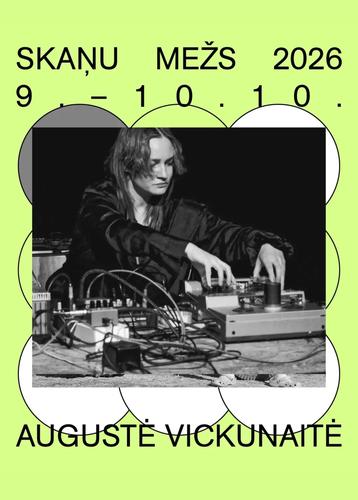
Augustė Vickunaitė: "Le poids de la journée"
Augustė Vickunaitė is a Lithuanian sound artist based in Belgium and Lithuania, with a background in physics, using reel-to-reel tape recorders to play, record, and create sound installations, articulating diverse layers of recordings including found material, field recordings, voice, musical instruments, objects, and the whole spectrum of malfunctions of decaying technology.
She has performed solo since 2016 and has played in various cities in Europe.
Le poids de la journée is a performance and installation for the human body, reel-to-reel tape recorders, and magnetic audio tape. The work was created during a residency at QO-2 in Brussels in 2025.
Performance The performance is built as a closed system in which the body and the tape machines become extensions of one another. The performer physically interferes with the movement of the tape, acting as a stopping force that prevents the machines from freely playing back the recorded material.
The performance makes visible the transformation of bodily energy into mechanical energy: the physical force of the body is transferred to the capstan motors, reels, and tape mechanisms, eventually becoming sound. The work explores an exchange of energy between the human body and mechanical analogue machines.
The sonic material recorded onto the tape is repeatedly restrained by the performer's body, preventing playback until the body becomes exhausted and can no longer hold the system back. At this point, the tape and sound are temporarily released, before being pulled, tangled, torn, and ultimately destroyed by the machines.
Installation What you encounter in this room is the installation that remains after the performance has ended.
The human body has been removed from the system. The tape loops continue to run between the reel-to-reel machines without bodily intervention or control. What was initially a relationship between the body and the machines has now become a relationship between the machines themselves and the tape.
The installation is therefore no longer interfered by energy of a human force. Its closed system is powered by electricity and mechanical movement. The tape loops circulate through the machines, while the machines continuously pull, release, tension, twist, and interfere with the tape. The system is left to operate without a performer determining its duration, rhythm, or outcome.
Instead of preventing malfunction, the installation allows malfunction to become an active force. The tape loops are left to encounter the mechanical limitations and irregularities of the tape recorders: they may become entangled, stretched, displaced, interrupted, damaged, or destroyed. These disruptions are not treated as failures of the system, but as part of its ongoing process.
In the performance, the body was the force that interrupted and resisted the machines. In the installation, that bodily resistance is gone. The machines are left to negotiate with one another through the physical presence of the tape.
The work thus shifts from an exchange between body and machine to an autonomous exchange between mechanism, electricity, and magnetic tape. What began as a performance of bodily exhaustion continues as a mechanical process whose duration and eventual breakdown are left open to chance.