 Editorial
Music (sound) and a different kind of presence
Rather than presenting a conventional essay, Leif Elggren reflects on his artistic practice through examples drawn from works spanning several decades. The texts accompanying these projects reveal recurring concerns throughout his oeuvre: communication with absent presences, hidden systems, sound as a carrier of memory, and recording technologies as speculative instruments. Instead of functioning as documentation alone, the project descriptions form a broader reflection on listening, perception and artistic method.
Emanuel Swedenborg: Angel Modulations
Emanuel Swedenborg - ANGEL MODULATIONS (CD on Ptroleum, PTR1001, 2011 59.09)
The recordings on this CD are from a session in Swedenborg’s summerhouse, Skansen, Stockholm, on the 27th of July 2007, during which I used my voice as a carrier of his voice. The results presented here were captured after several days of attempts to get in contact, to bridge the gap between this world and the other, this existence and the other, or whatever we can call it. This is just a first simple experiment trying to follow Swedenborg’s own way of establishing contact or communication. And please remember, what is interesting here is what is happening between the words, what is happening under or over, over or under – the voice as an irregular sound generator.
"We are born to become angels. We are unable, while in this world, to understand the peace of heaven because human words are inadequate. Angels know no greater happiness than caring for and instructing those who arrive from the world. We are spiritual beings but live in material bodies so that we can function in the natural world. The two innermost things of heaven are innocence and peace, and they proceed directly from the Lord's Divine Love. To grow old in heaven is to grow young. Those in heaven have keener sight and hearing, and also are more broad-minded than when they were in the world. It is like the difference between clear sunshine and dark clouds in the world. We are not human beings because of our bodies, but because of our spirit. Death is simply passing from one world into another. All in heaven receive joy in sharing their delights and blessings with others. Divine providence does not look to what is temporary and comes to an end when life on earth comes to an end, but looks to that which remains to eternity, which has no end. The universe is like a stage on which life is continually being exhibited. The life that leads to heaven is not a life of retirement from the world, but a life in the world - evidence that there is a God. We are all instructed by angels after death. The light of the world is little more than a shadow in comparison with the light of heaven. Every person is created to live forever in a state of happiness." (Heaven & Hell, Emanuel Swedenborg)

Emanuel Swedenborg, that old seer of visions, at the age of 56 had a revelation and totally changed his life. From being a rational scientist he became someone that never saw any limitations. He dedicated the rest of his life to vertical communication. He had daily contact with another world; spirits and angels gave him exclusive information that few among humans earlier had experienced. He joined that old gang of prophets and visionaries and did not even hesitate to interpret and correct the bible. He revealed the hidden mechanisms that rule our lives and all of the universe. With his brave attitude he has inspired many. Others have seen him as a lunatic (Immanuel Kant). Even if he during an early period was influenced by a meeting with King Carolus XII he stood totally free and independent in relation to the church and state. The last ten years of his life he slowly, step by step, faded across to the other side, a slow transition into that world he so carefully had described. He left an extensive and delicate piece of work after himself. He left it in this form of existence that we call LIFE ON EARTH.
Recordings: 1: 03.13, 2: 09.30, 3: 02.36, 4: 08.27, 5: 06.38, 6: 06.01, 7: 22.25.
Earlier versions of some of these tracks were published by Antifrost Voice Tapes Series vol.2, spring 2011.
Cover image from the account by J. Vilh. Hultkrantz: The Mortal Remains of Emanuel Swedenborg,
presented and published May 6th, 1910.
Published by Touch Music [MCPS]
Eleven
I communicate with my dead parents through eleven. Eleven has become a sort of generous open channel between us. My parents died in 1996 and 1998. My father turned 90, and my mother 92. They had always been together. Not always happy, but anyway good partners. Some disappointments, of course. I know that my mother wanted to become a teacher when she was young. But unfortunately, she stayed home to provide support for my father. When she grew old, the disappointment came through. A sort of bitterness. When she was 90, she was very dement. She showed her anger, never for me, but towards my father. So for the first time in their life together, there was an open conflict between them. If you can call it open when one is halfway in the land of the shadows and the other is struggling with fear and anguish. Fading out, slowly. It is not easy to grow old. I was witnessing this very closely. I had seen them since I was a small kid. They had seen me since they were 44. We had a long relationship behind us that was coming to an end. They had cared for me, supported me, and respected me the whole time. They saved my life. Made it possible to survive. They cared for me since I was two years old. And brought me up like I was their own. That helped a lot. I called them father and mother. And I was very sure very early on that I should become an artist. The only way to structure inner chaos. The only way to structure a possible existence, and by that, at least, a thinkable future. That helped. And I became an artist, not a soldier. If this had been before the First World War, or even before the Second World War, I would have been a soldier, not an artist. But times changed after the Second World War. The post-war society made it possible to be mentally and spiritually mobile, not to say economically and physically. In another way than before the war. The post-war society built on the ruins of Europe quickly became fertile ground for a new welfare system unlike any seen before in the Western world. But there was, of course, a huge trauma behind it all. And that is where the artists came in. As channels to the underground, to the pain and the suffering. A new (both mental and real) sewer system had to be built. A disposal business. And someone had to do it. The disposal. It was not easy. But it was a relief. To combine the personal history and that of the society. To combine the inner and the outer in a balanced way. As an exchange. It helped too. And the hero was no longer a soldier. The hero was an artist. The idol.
I communicate with my dead parents through eleven. I did not know about this until recently. I mean, I was not aware of this function, this possibility, until just recently. It just stood clear one day. I have been focusing on eleven for many years. Observing and focusing. Yes. But I did not really realize why until some years ago. It was like I had been digging or preparing for so long. Without knowing what I was doing. Like stumbling in the dark. But having a convincing feeling of being on the right track. And suddenly it was totally clear. Like a breakthrough. Like a tunnel that opened up and the light came through. It was accessible. But so fragile. I am trembling as I write this. I am not sure about how to handle it. It is like a gift not meant for me. for someone else, someone that is not me. And I have just got a glimpse. I am grateful, but scared. Will this be taken away from me? I have an open channel. And that is a tremendous privilege. But I do not even dare to use it. like economy. You know. like a certain amount that you have to take care of. Be careful with. total respect. I am privileged. I communicate through eleven. It is an open channel. I am trembling. I am scared. At the same time, grateful. I communicate through eleven. Like an open channel. It is so clear. I can hardly write this. It is like poetry. It is like being part of what it's all about and being aware of it. Or maybe not, maybe not. I am not sure. I am just overwhelmed by the possibility of communicating with my dead parents through eleven. But still only a glimpse. A narrow line. Indirect. Like communicating using the copper rods / the copper pipes. (See Talking to a Dead Queen.)
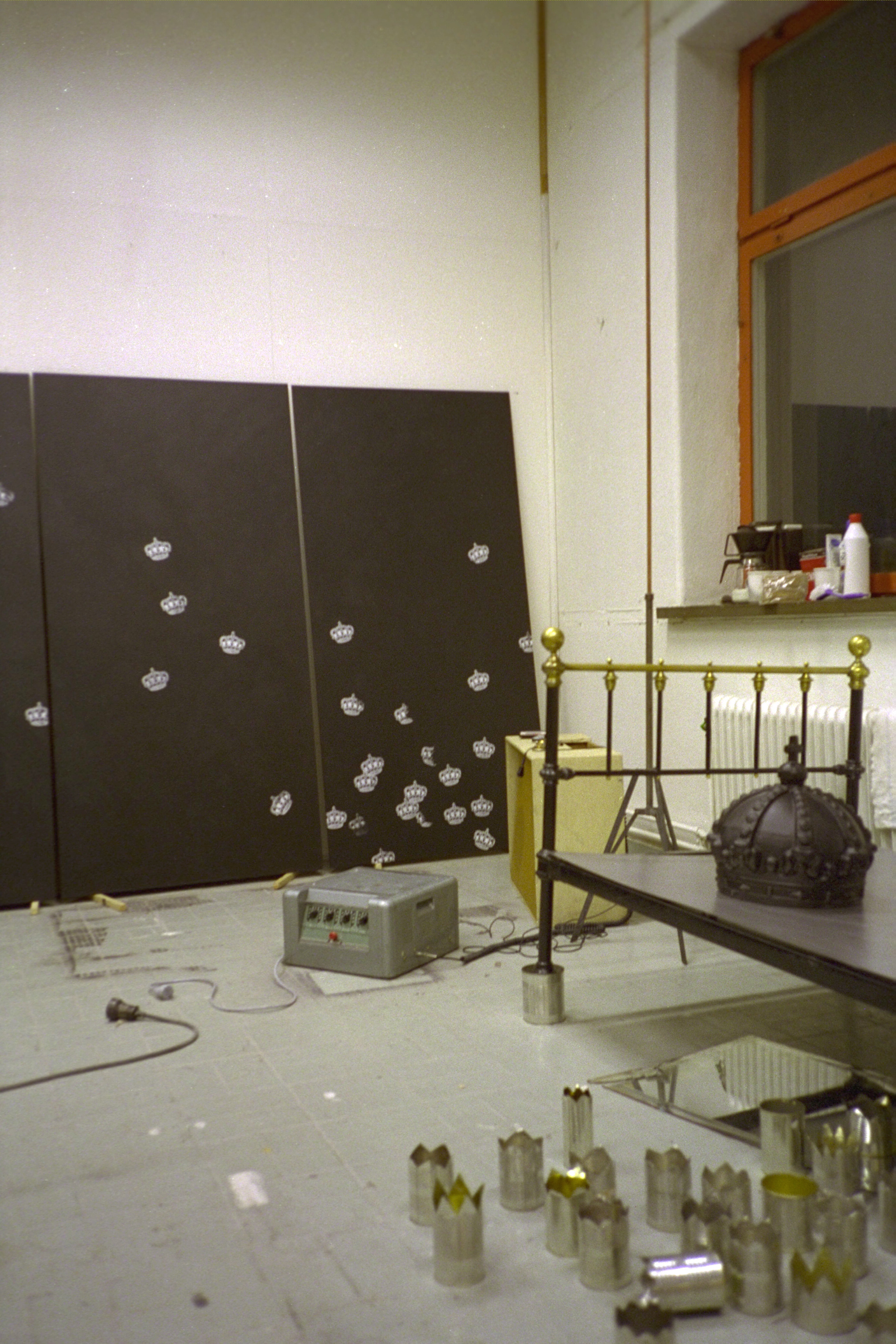
You know, like in the First World War. The trenches. When they rushed up from the trenches and ran through the open field. And the first line had to lie over the barbed wire. The first line had to throw themselves over the barbed wire. Yes. And all the others, all the others. The second line, the third line, etc., had the possibility to climb over the first line. Quick and easy. To advance. In the bullet rain. And the guys beneath. Yes! The guys beneath. That made it possible. And they knew it. They were aware of it. Of course. But they had to do it. Someone had to.
But I, I communicate with my dead parents through eleven. And that is a privilege. Nothing, of course, nothing to compare with the soldiers on the barbed wire. Absolutely not. They had to do it. Someone has to do it, and everyone does it. Yes. You know, of course. Everyone does it. In a way, it is totally basic. And I communicate through eleven. But I am scared. Not for the privileged communication. But for talking about it. But I have to do it. Yes. But I hesitate. But have to do it. Yes. I have to do it. It is like poetry. It is like poetry. Like having a glimpse of something that is not for me. Yes, and I am scared. But I am happy. And that is why I have to write about it. Yes. That's why I have to reveal it. To talk about it. Because I am excited. Yes, I am excited. I am communicating through eleven. Yes, every day, almost every day. And that is so encouraging. So encouraging. Yes. I communicate through eleven. It is like an open channel. Like a narrow pipe that is two. A narrow pipe that is two. Like being parallel, but anyway connected and communicating. You know, like two dead ends that are overlapping each other and communicate through another way. Through another way. Not direct. No, not direct. But sideways. Yes, sideways. Using another technique. Yes, using another technique. That's the way. An unexpected new technique. Unknown. Sideways. Surprisingly. Like transmitting the molecules or frequencies in another direction. Yes, in another direction. But still working with the same purpose. With the same mission. You know, imagine two copper pipes. Two water pipes that should normally be connected. That should normally be one after the other, but they are now overlapping by a portion of their lengths and are still doing what they should. Are still working. Are still doing their job, their function. But sideways. Without doing it in the so-called normal way. Communicating without being directly connected. Sideways. Like the molecules and frequencies taking another unexpected way. Like everything always being somewhere else, somewhere else.
Talking to a Dead Queen
Well, to get around to the subject of Talking to a Dead Queen, the background is that I’ve always been interested in Queen Christina. A few years ago (1993), I built a 1:50 scale replica of her coffin. – Her tomb in St. Peter’s in Rome, where she had been lying since 1689, was opened in 1965 in the fervent hope of finding something that might explain why she had renounced power and crown (she may have been androgynous, a hermaphrodite – speculation along those lines has been rife), betrayed her father, and converted to Catholicism. Through the centuries, there have been rumors that something was hidden, that there must be a secret reason – after all, you don’t just decline to take the scepter, to be the ruler of the Kingdom, to attain the highest of all human positions of power. Nor did she want to get married, to find a King for the realm. To rule alone wouldn’t do, after all. She must have been under an enormous amount of pressure. At any rate, I found the drawings for the coffin, the wooden inner coffin that had been concealed within the richly decorated marble sarcophagus that is still in St. Peter’s. I built five identical models of the coffin. I place a TV monitor in each one and screen Greta Garbo’s interpretation of the queen in Rouben Mamoulian’s 1933 film Queen Christina. A role, incidentally, which must have suited Garbo perfectly. Her identification with the character must have been complete.
To these coffins I attach a sort of antenna, a long, thin copper pipe placed in a stand next to each coffin. The vertical contact. Later, I remember reading in Napoleon’s diaries from St. Helena, in which he mentioned, in passing, a strange thing: on a number of occasions, he experienced a sort of vision, seeing some kind of bronze or copper staves suspended in the air next to him. These visions always occurred on the eve of a decisive battle or a similar event. The staves vibrated, giving off a dark, humming tone through which Napoleon heard voices. These voices introduced themselves and gave him advice and instructions for the coming battle. The voices belonged to figures from the past who served as examples and guiding lights during Napoleon’s childhood and development (e.g., Caesar, Charlemagne). – Now he encounters them again, at an important moment, and feels he is being given concrete information about how to plan and act. – Naturally, I see the connection with, and possibilities of, my antenna – my copper pipe. An aunt on my father’s side dies at about this time, an aunt I really liked, and as her funeral approaches, I decide to connect an amplifier to the copper pipe via a contact microphone and attempt to make “contact”. After the funeral, on the same day, I record the material that will form the basis of the CD. With the help of feedback phenomena, I start up the pipe and let the low-frequency sound waves pour into the room. I position myself between the speaker and the pipe. I make careful movements, and the smallest shift in my position changes the sound image, affects the sound waves, as though I were standing in water. It becomes a sensitive instrument, reacting directly to my body’s presence and movements. The sound waves slowly interfere with each other in the room. Naturally, I dedicate the CD to my aunt, who had a peculiar characteristic throughout her life. She could fall asleep anywhere, at any time. There are several photographs of her asleep at family reunions and the like. This was always a source of great fun. – And further: in a perfectly natural manner, for me, her image coalesces with that of Queen Christina…
This, then, is charged stuff, and I willingly regard Talking to a Dead Queen as an attempt to contact the other side and, furthermore, through the multiplication of the CD, as an attempt that is repeated every time someone plays it on their home sound system.
https://leifelggren.bandcamp.com/album/talking-to-a-dead-queen
Under The Couch
The nose points upwards, to the ceiling, to the sky. Like a dead on lit de parade or for an autopsy. Like a heavy sleeper. Like someone somewhere else. But being observed by the observer. Being recorded by the recorder. And the spot in the ceiling, mirrored by another one under the coach. Reflected. Like the classic image of the hierarchic triangle being folded down, revealing the other side of how things are. Like trash. The other side: darker than dark and totally invisible. But maybe hearable. Like a layer under a layer. Like the hidden mechanisms of gravity. And the bed acts as a filter, letting some things through and others not. As always: the finest particles (or structured complex clusters of stray frequencies). Like leftovers. Maybe even like leftovers. Total respect to the second level, but there is also a third level, and a fourth, and God knows if there is not even a fifth and a sixth, etc. Total respect to the dreams and the fantasies and the imaginations and the hallucinations and the talking and the direct communication between the lying one and the sitting one. The visible and the hearable. But under that, underneath these observable levels, other levels, like in that emptiness, like in that silence, like under that presence, or beyond maybe. When the space is totally empty, dark, and abandoned. By itself. With other frequencies at work. Like something dark in the dark. Like a shadow of a shadow. Like a dream in a dream. Like when you were a kid, and the only free and independent space was under the bed where a total Kingdom was hidden, accessible only to you. And still are. Still there. Right now. Always. Like a levitation, downwards. I remember when my father passed away. Faded away, better to say. It took him two weeks. On the threshold, on the border; sometimes here, sometimes there. Without really wanting to lose the grip. Half awake, half asleep. But slowly fading. Step by step. Inevitably. It was like watching him sink. Like an elevator in slow motion, slowly sinking. Going down. Carefully loosening the threads one by one until he disappeared. Down. Under. And my mother too. But it took a bit longer for her, almost a year or maybe two. Almost becoming a child again. A newborn. Wanted to return. Wanted. Waiting to go back to where it all started. And do it again, and again. A new level. And another one again. Like changing frequencies.
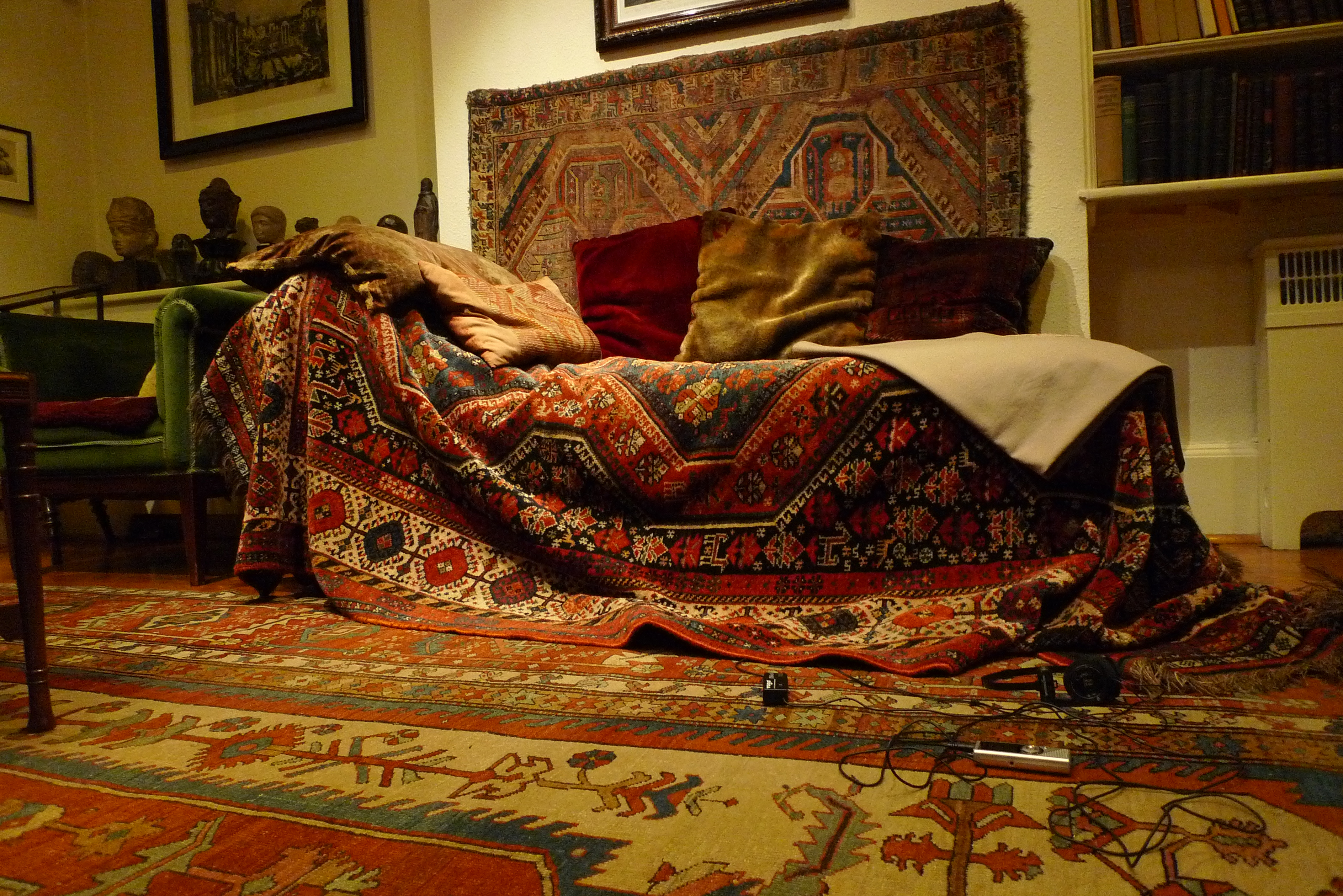
UNDER THE COUCH. CD on Firework Edition Records by LE. The booklet contains an essay by Lucia Farinati. - This recording was made under the famous couch of Dr. Sigmund Freud at 20 Maresfield Gardens, Hampstead, London. Sigmund Freud (1856-1939), founder of psychoanalysis, lived here from 1938 to 1939. The house is now the Freud Museum [www.freud.org.uk]. From the museum’s website: ”Freud’s couch, upon which his patients would comfortably recline during psychoanalytic sessions, was normally covered by an Oriental rug throw. Underneath the throw, it is a plain and simple structure, raised by a scroll and pad at one end, though fully upholstered with springs and horsehair stuffing. The couch is rather short, so that the patient would not lie horizontally, but with the head quite high, supported by several cushions and pillows. According to Freud’s wife, Martha, in an interview with Princess Marie Bonaparte in 1938, the couch was given to Freud by a grateful patient, Madame Benvenisti, in about 1890. - Duration: 60' 05''. Recorded on the 14th of September 2011. Recording devices: ZOOM H4n, Voice Recorder Diasonic DDR-5000, Mini Cassette Recorder Olympus S701. Cover and label photographs by LE taken during the recording session. Many thanks to the Freud Museum for so generously having me under the couch. Special thanks to Lucia Farinati and Dr. Sigmund Freud. FER1100 (P)&(C) Leif Elggren, Stockholm, London, New York 2012. BIEM/N©B LE is published by Touch Music [MCPS], London.
The most important thing with this project is the method, the attitude, and the process of doing it, doing the recording UNDER the famous couch, as a sort of parallel to the psychoanalytic method. And presenting it as a report from this "underworld". Using the recording devices as tools to detect, to extract what might be hidden there, through more than 100 years of Psychoanalytic practice.
You can see this audio CD as a report from this investigation of the sounding "unconsciousness", the couch's unconsciousness if I may say so. I have been working with the recorded material, trying to extract some "information" out of it. I am happy with the result.
The delicate and subtle information is there, of course, but maybe difficult to hear. That's how it should be. It is more about this being done and the "method" than anything else.
https://leifelggren1.bandcamp.com/track/under-the-couch-excerpt
Excerpts from the CD booklet Extraction and the book Genealogy
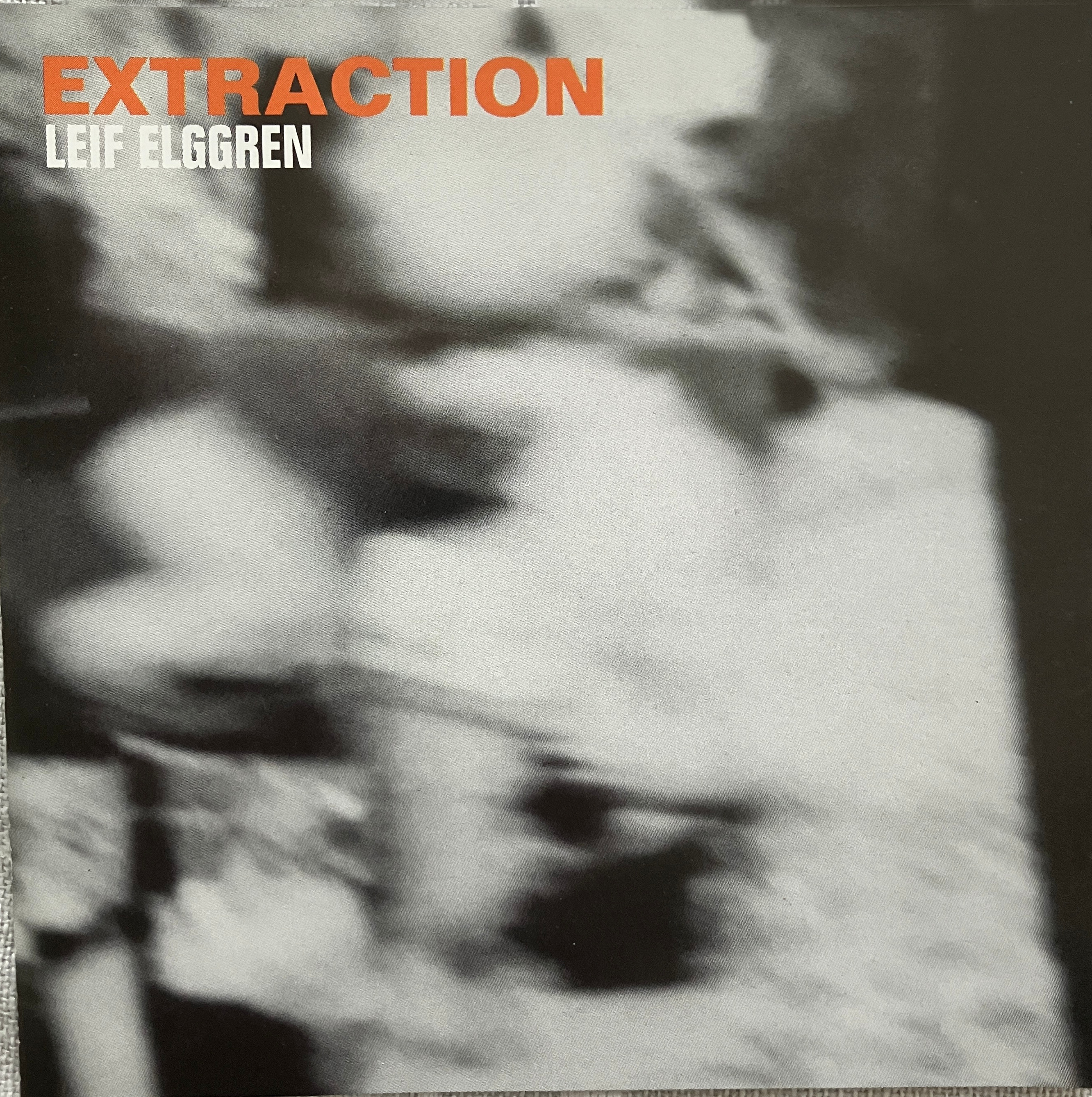
I would like to quote from my CD EXTRACTION: “To leave the periphery and be in the magnificent center.” (CD, 57’ 25’’, FER 1039, 2002.) ”This basic sound material was recorded in my biological mother’s uterus with my not-yet-developed teeth used as a fundamental and simple recording device, a few days before my birth. This sound material was kept hidden inside one of my wisdom teeth until recently, but has now been brought to light. Digitally mastered, reproduced, and emitted into the room which we all mutually share and which we usually call reality, the world. Emitted with the main purpose of changing that room. You do not necessarily have to listen to this CD; the sound material should be considered more as a tool, a tool with a special purpose, favorable but dangerous. For best results, load this CD into your CD player, confirm that sound is coming out of the speakers, and then just leave the room. When you come back, everything will be totally changed.”

But also from the book GENEALOGY - §32 UNKNOWN VEHICLE - ”Relates to my unknown father who was said to be a driver for many years. I never met my father and I never saw him drive his truck, but I had a lot of fantasies around him and his car when I was a kid and I hated all those trucks I saw everywhere, he could have been in any of them and I was so afraid, afraid that he would run over me with his car, that he hated me and wanted to see me dead, he was a violent person. - This is, however, the basic stuff that we, as humans, have used to create what we call religion, what we call God (the mythology of the past and what we use to make the unknown understandable). God has always used a certain vehicle to transport Himself over the long, timeless distances. This is so fundamental, so basic in our lives, but it has always been so misused by authority to control people.” - So, what I want to say is that it was totally inevitable for me to start working with sound, with music, with the hearable.
Claude Mellan / The Sudarium of St Veronica
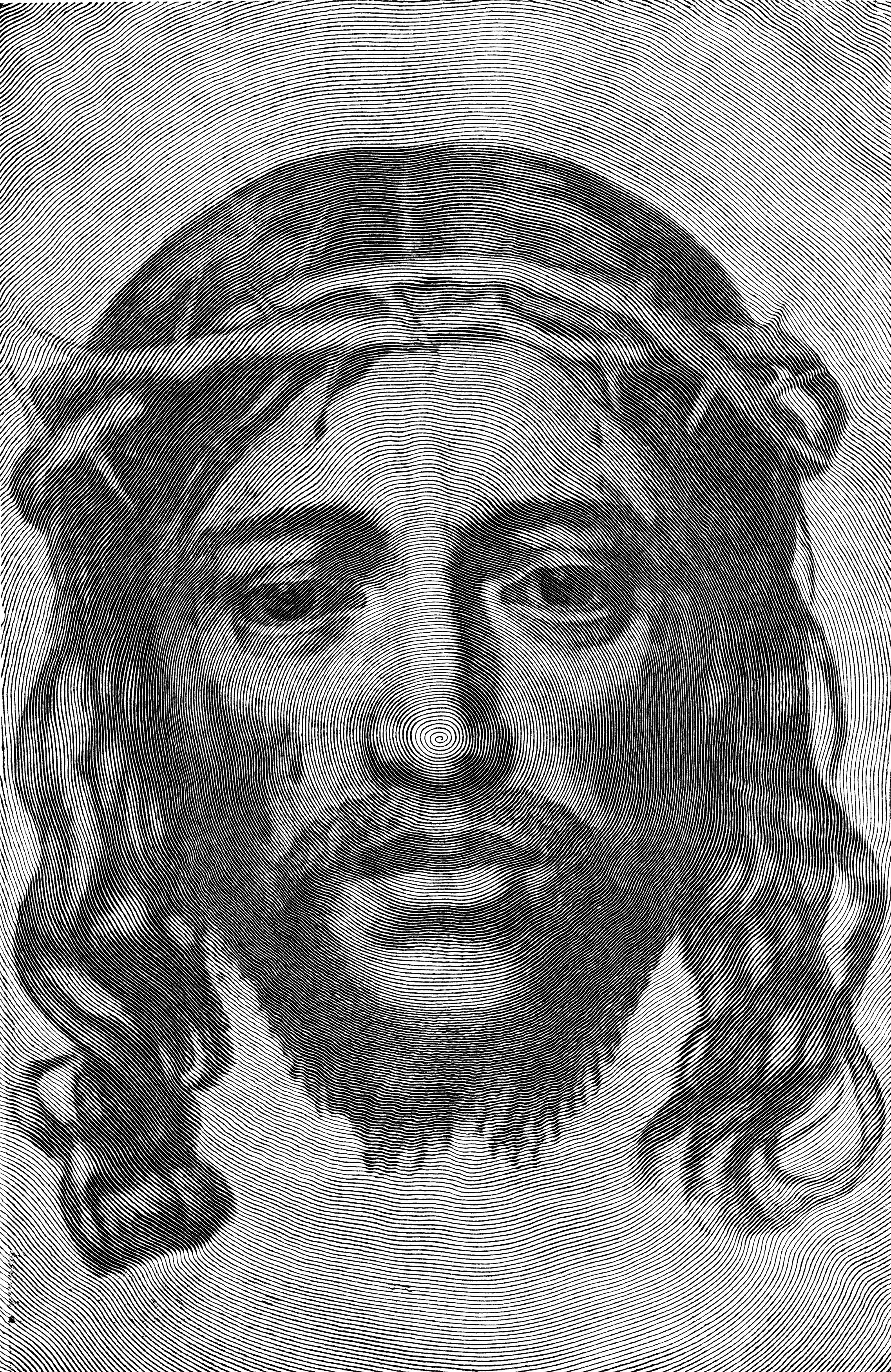
For many years, I had admired the print by the French artist Claude Mellan (1598-1688), titled the Sudarium of St. Veronica, from 1649. A portrait of Christ is engraved through a continuous spiral line that starts at the tip of his nose. I realized early on that this must have been the first cut (maybe ever) of a record. So obvious and natural. And so beautifully done. Could it even be possible to play back the gravure in an old-fashioned analog way? But then I needed the plate. To play the plate! I was really excited by the thought of detecting what was hidden in that line. To hear the image! But I needed a print that I could scan for to etch and make a new copperplate. The original plate was, of course, not even worth thinking of, if it still existed. I tried to interest the people at the National Museum in Stockholm because I knew they had at least one print in their collection. I talked to several of these guys, including the boss. But they were not interested at all in helping. Instead, I tried to find another way through the library at the Academy of Fine Arts. I had heard of high-quality heliogravures printed in old books. I had very good help from the librarian Anneli Ekström. She finally found an old book with legible print. I scanned the heliogravure in the highest resolution and worked with the image in Photoshop. For more than a year, I was working on cleaning the image. Trying to erase as much of the blur around the spiral line as possible. Trying to get the line as clear as possible to make way for the pickup. When this disposal job was done, I made a positive offset film and sent it to Svensk Industrigravyr in Hyltebruk in the South of Sweden, and they made a perfect etching of the image. Not a copy of the original plate (that was an engraving) but a close replica, as close as I could get.
Stockholm, July 2007
The basic sound source for this CD is the copper engraving “The Sudarium of St Veronica”, cut by the French artist Claude Mellan (1598-1688) in Paris 1649. A portrait of Christ engraved through a continuous spiral line that starts at the tip of his nose. An old heliogravure (a 19th Century reproduction of one of the original prints) was used to make a photo etching in copper to get a replica as close as possible to the original plate. This plate was played back with a specially constructed record player and recorded at Firework Edition, Stockholm, July 17, 2007.
Three different recordings were made:
1: 21’34’’ (Turntable. By hand. CCW. Drypoint needle.)
2: 16’01’’ (Turntable. 33 rpm. CW. Drypoint needle.)
3: 14’48’’ (The plate on a table and the needle moving CW. Drypoint needle.)
Total time: 52’23’’
These recordings are totally fresh and not manipulated in any way. See this CD as a presentation and a report of the first three recordings ever done of this 358-year-old engraving.
Background:
During so many years, I was doing engravings with a drypoint needle in 1 mm copper plates. It was mostly figurative imagery emanating from my dreams. First, I often did a drawing from a certain dream, and from that, a small series of engravings was developed. Like “The Gardeners”, “The Knife Suite”, “Street Dogs”, “I and Me”, “Africa”, etc. From these images, I began making installations with furniture and objects. I even used the images as sketches or scores for performances. Dressed up like the characters in the pictures. Started making books where I wrote down instructions for the performances. And soundtracks too. After a while, I wanted to combine my work with the drypoint needle and all the other stuff that was developed from it. It was very natural. I decided to do a project in which I recorded the sound while engraving a small copperplate. I had been focusing for such a long time on the images I was scratching into the mirrored metal, but at the same time I was producing a lot of sound with the needle as it worked in the soft, reddish material, without being aware of it. Now I wanted to focus entirely on the sound generated. CM von Hausswolff and Erik Pauser helped me to find a good place in Gothenburg for the recording. It was an old abandoned slaughterhouse at Haga Östergata 25. We had to climb over the rooftops to get there. All doors and windows were blocked. We found a nice room where we installed the recording devices. We attached a contact microphone to the back of the copper plate. I did the first recording in a light room. Seven minutes trying to cover the plate as much as possible with the drypoint needle. The second recording was done in a totally dark room. I used a burnisher and tried to erase as much as possible during seven minutes. This was done on the 23rd of November 1981. After this session, I went back to Stockholm and printed the plate in a copper print press. 252 copies were made. With lead types, I put together the text for the different text sheets and printed it in my old letterpress, a Korrex from 1963. A seven-inch vinyl record was pressed by a pressing plant in northern Sweden. I had a personal contact in Linköping, in southern Sweden, with an old cardboard box manufacturer who made a very nice black box for me. On top of the box, I made a relief print with the chemical symbol for copper: Cu. In the box, I placed the seven-inch record, a print from the plate, a photo from the recording, a text sheet with the instructions for the piece, a credit page with all the print information, and a title page. This was a crucial point for the work. I could not only see the image but also hear it!
Several years after this, I wanted to go further and bought two seven-inch lacquers from a cutting studio in Solna, right outside Stockholm. I remember when I was there and picked them up. They were packed like a cake in a cardboard box. Very fragile. I took the box like a baker’s delivery boy and walked carefully back home. I placed the lacquer on a record player and played it on the lowest speed. I took my drypoint needle and tried to act like a human cutting machine. I had a sentence that I screamed out loud over and over again. A true cutting machine is performing an inexorable spiral from the periphery to the center. As a human version, it was not that easy. The needle was extremely difficult to control, and the lines kept crossing. But the thing was done, and this was released as a hand-cut seven-inch called The New Immortality on Anckarström/Firework Edition in 1992.
Because of the crossing lines in the vinyl, this was (and is) a very difficult record to play back. The pickup was jumping around on the surface, and every playback was a new one. The record was more like a sound source. An instrument. Not two playbacks sounded the same. So it was necessary to follow this up with a second release, The New Immortality 2, on Firework Edition Records in 1998. This release was based on two playbacks of The New Immortality.
Virulent Images Virulent Sound
Artist: Leif Elggren
Title: Virulent Images Virulent Sound
Format: CD
Firework Edition Records
Catalogue number: FER 1044
Time: 62'13''
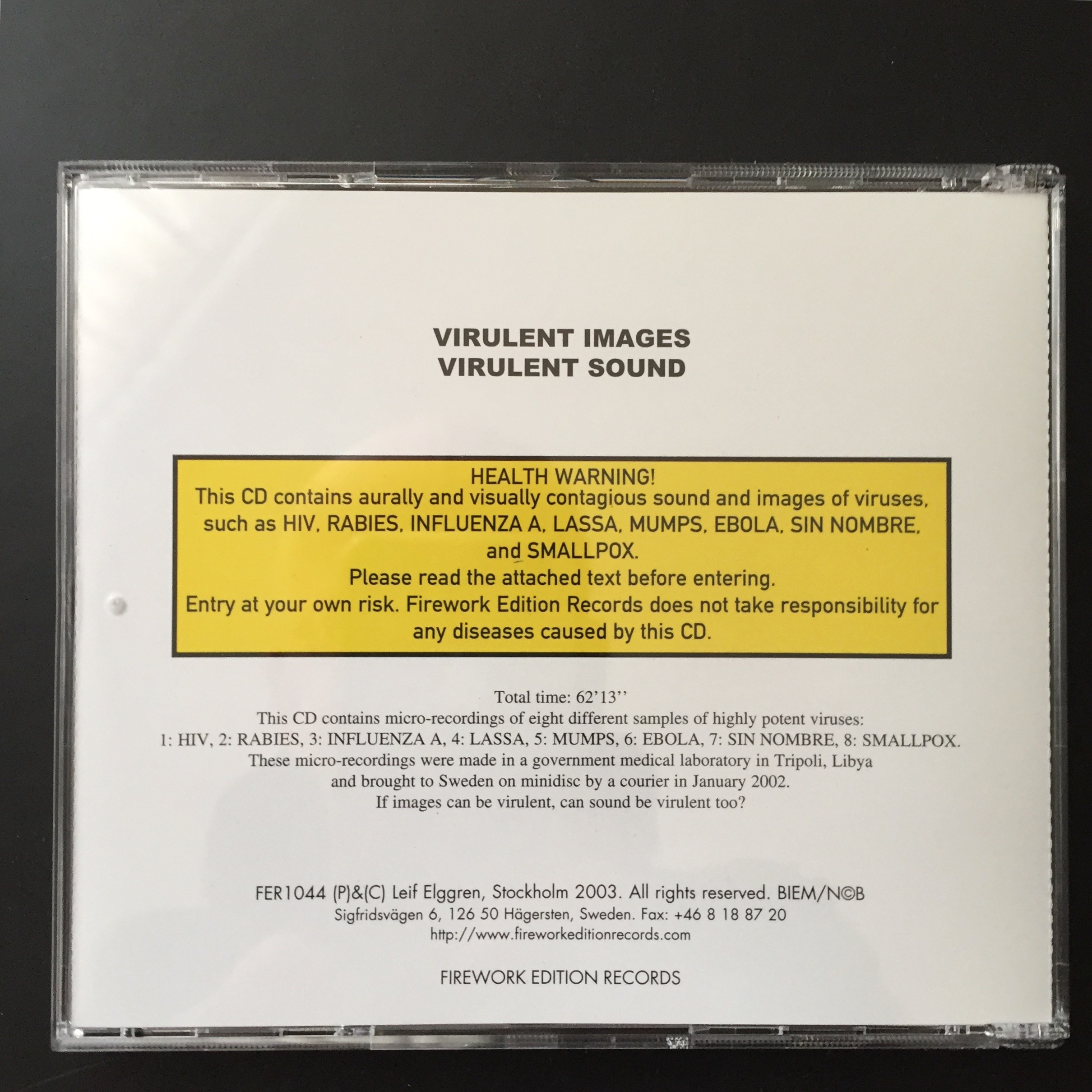
This CD contains micro-recordings of eight different samples of highly potent viruses:
1: HIV, 2: RABIES, 3: INFLUENZA A, 4: LASSA, 5: MUMPS, 6: EBOLA, 7: SIN NOMBRE, 8: SMALLPOX.
These micro-recordings were made in a government medical laboratory in Tripoli, Libya and brought to Sweden on minidisc by a courier in January 2002. If images can be virulent, can sound be virulent too?
Health warning!
This CD contains aurally and visually contagious sound and images of viruses.
Please read the attached text on the CD-cover before entering.
WARNING!
Do not look at the image!
According to new but classified reports from scientists inside the NASA Medical Research Laboratories, evidence has been found that viral diseases such as cancer, AIDS, Ebola, etc., are being transmitted through visual aspects and methods. The viruses carry their capacity for infection in their shape. To see a virus run the same risk of infection as physical contact with the virus. Even a glance at a photograph of the Ebola virus, for example, is sufficient to cause danger of infection. The visual structure of the virus system strikes the eye and transforms its information in the human brain back into a substantial living virus that will attack certain parts of your body. It is a delicate dematerialization-materialization process in which the images are used by the viruses as a very patient but effective vehicle for dissemination and to exploit new ways of taking over the world.
– Don‘t look at the image!
Is it possible that what we see has a direct physical implication on our bodies? We are taught to regard what we see solely as something which is received through the eye and transmitted to the administrative center we call the brain, and there to become the subject of intellectual processing, storage, comparisons or perhaps even to cause orders to be dispatched to various parts of the body, for the movement of various muscles which will have physical effects in the outer sphere, where interaction will occur with other bodies possessing similar administrative centers. These are phenomena that we are used to and, in a spirit of concord, we fully accept. But when, as now, a leak from a usually reliable source begins to divulge secrets from NASA‘s Medical Research Laboratories, secrets about the eye being capable also of transmitting purely physical conditions, such as viruses, this is nothing less than a revolution in the way the biological body is viewed. According to these sources, it seems that a person can watch a virus attack, say on the surface of another person‘s skin, and transmit this image via the eyes to his or her brain, where it will be received, processed, and then replicated as a physical structure similar to the one observed, which will immediately attack the new body. Science describes the eye as the surface where the interface we call reality, or the other sphere, materializes and makes itself comprehensible, in social and psychological concord. The fact that scientists have now, in a miraculous sort of way, discovered that viruses can transmit themselves via the eyesight of humans and probably of animals, is really only the first step in a new way of looking at our understanding of that part of the outer sphere which needs the light of day in order to be internalized. Many experiments have also been conducted using photographs of viruses taken with scanning electron microscopes, where the viruses are vastly enlarged, and these have shown that the viruses' capacity for transmission remains intact. The visual structure of the virus is thus simultaneously the code or formula that forms the basis of its physical structure, is reproducible, and can be materialized. In other words, viruses seem to be able to transmit their aggressive, contagious function via a photograph: the visual structure is read by the eye, processed by the brain, and then reassembled as an active substance in the new body, thus having performed an “immaculate conception“ using the visual medium. – If this is really true, it opens up unprecedented possibilities. As an artist, it is slightly giddying to think of the possibilities of using the two-dimensional image to influence and interact in ways one would earlier only have dreamt of, while suffering the deepest and most frustrated doubts about one’s role and task. It would also be a powerful and, in the most literal sense, deadly weapon in the hands of madmen. A weapon millions of times more powerful than the little puff of sarin released in the Tokyo subway by the Aum Shinrikyo sect in 1995. Imagine: a poster campaign of photographs of the Ebola virus, massively enlarged, posted on the walls of the world‘s cities during the night – fully feasible with today‘s world-spanning subversive networks. One look at these posters on the way to work in the morning and an Ebola epidemic would ensue, kicking off a galloping Apocalypse worse than the most horrible of horrific visions that men, over the millennia, have worked so hard to create, the most unspeakable bloody nightmare scenarios that we can hardly even picture in our most extreme nightmares. (Being excluded from the vision of Paradise has always created an opposite reaction and nourished grand dreams of the highest form of revenge.) A tool, or a weapon rather, to outdo all others we have previously gained knowledge of, and whose availability and usability is proportional only to the individual and personal responsibility we as individuals have (and ought to have!) because we were born on this planet and possess the ability to observe that which is outside of ourselves, that which we call reality, which we call “the other“.
--
A first version of this text was refused publication in Delo, a Slovenian newspaper, and in Der Standard, an Austrian newspaper, in June 2001. But the above text and four representative color images (blanks) were published in Morgenbladet, a Norwegian daily newspaper, on the 12th of October 2001, in conjunction with Rotation, a NIFCA project curated by Mats Stjernstedt.
The above text plus eight photographs of HIV, RABIES, INFLUENZA A, LASSA, MUMPS, EBOLA, SIN NOMBRE and SMALLPOX were shown in a special room as part of the project ArcArt, Nordnorsk Kunstmuseum, Tromsø, Norway, January 2002 and Stunt Club, Det Intermediale Rommet, Kunstnernes Hus, Oslo, Norway, February 5-7, 2002.
A short version of this text was published as a warning in the daily newspaper Aftonbladet, Sweden, August 29, 2002.
The above text plus eight photographs were shown (behind a curtain) in a special room as part of the project Transformer at Pori Art Museum, Pori, Finland, September 18 - November 10, 2002. This can be considered the first time this project was presented in a complete version. This installation/set-up is now also part of the permanent collection of the Pori Art Museum.
The whole informative text was published by Alexandra Mir in the Daily News, New York, September 11, 2002.
… about the suspension of time and space, about the future and about the possibility to move freely along all coordinates simultaneously, about the realization that everything is impossible but lies open before each and every one of us, about miracles, about the inevitable desire to dominate the world, about violence and about death as a lifelong friendship. (Genealogy, Firework Edition, 2005)
Bio
Leif Elggren (SE) is a writer, visual artist, art book publisher, stage performer, and composer based in Stockholm, Sweden. His varied and prolific output routinely involves dreams, subtle absurdities, and social hierarchies turned upside-down. His works often include iconographical material like royal crowns, emblematic symbols, viruses, contagious diseases, furniture, and the combination of yellow & black. His audio works are often created as the soundtrack to an installation or a performance. Together with Kent Tankred, he started the performance group The Sons of God in 1988. He is also the founder, together with Carl Michael von Hausswolf, of The Kingdoms of Elgaland-Vargaland.