 Editorial
Sounding Microbial – ears, voices and sonic relations with our microscopic counterparts
Can you imagine bacteria, viruses, yeasts, moulds, spores, algae and fungi as listeners? Can you imagine what they hear? What they would answer back? Molecular screams, enzymatic gestures?
Microorganisms constitute planet earth. Not only do they inhabit the ins and outs of the human body or any other animal, they make up our soils, oceans and atmosphere. They mediate digestion, nutrient absorption, they disintegrate organic remains, photosynthesize and in many ways regulate the earthly climate – they “support the existence of all higher trophic life forms” 1 on earth. As we share every livable environment with microorganisms, we also share our environments of sound: from outdoors to indoors, from our throats to our ears 2. In this essay I’ll address how sound manifests at the microbial scale and review how it’s studied in scientific literature. Furthermore, I will introduce Microbiophonic Emergences, a multifaceted art-science practice investigating the sonic relationships between humans and microorganisms.
I’d like to note that in this essay, I will be using terms “sound” and “vibration” interchangeably. Sound is used to describe mechanical vibrations that are being audited by hearing organs 3. Even though the term “sound” can be expanded as ultrasound or infrasound, to address a hearing range beyond human, in the vastness of all possible vibratory relations, it is still limiting, for example, when talking about earthworms sensing surface vibrations caused by raindrops, fish and their lateral line, or microbial responses to sound. Due to these indeterminacies, I will assert that everything that receives vibrations impactfully – hears, whether through specialized auditory organs or not: all vibrations will be treated as sound and vice versa.
In the voice of a cell
Microbes are rarely debated in the context of sound. And rightfully so, as the nanoscale microbial movements are inaudible to our naked ear. Nevertheless, in some cases, our ear is actually the primary tool for reasoning with microbial processes, even when it’s hard to associate causality with something as intangible as cells. For example, when you open a bottle of natural cider, kombucha or kwass, a whoosh of gasses escapes through the slim opening of the cap. That steamy whistle is pressurised gas – a biproduct of microbial processes run by yeast and Lactobacillus, which are at the core of every fermented product we consume. Most of our bodily bowel sounds are also of gaseous origins and most of the gases can be attributed to our colonic flora 4, in turn, making all of us engaged in a sonic relationship with microorganisms – the traces of activity of millions of bacteria at once. However, individual cells are not as mute as initially thought as well.
Microorganisms are in constant motion: they are secreting, absorbing, flagellating, replicating and even periodically oscillating 5. Since the rise of microbiology, these processes have been visually observed and confirmed but never audited. To capture movements at such a small magnitude, no conventional microphone technique will suffice, since the movements are on the scale of nanometers – ranging from only a few to a mere 30 nm in physical displacement 6, but recent advancements in nanosciences finally allowed us to turn our ear into the microbial world.
The primarily described approach was the Atomic Force Microscope (AFM) based nano-motion detection 7. It utilizes the AFM’s hypersensitive needle – quite similar to the stylus on a record player. The needle movements are recorded by shining a laser into its surface and measuring the change in reflection. Eventually this allows to map out the topography of the specimen. However, unlike in nanoscale imaging, nanomechanical motion detection utilizes the tip of the cantilever in a fixed position, in contact with a single cell, this way capturing the vibrations transferred into the cantilever. The experiments conducted by the team of Pelling et al. on baker’s yeast (Saccharomyces cerevisiae) showed significant motion and even resonance on specific frequency bands: “The motion of the cell body of a typical yeast cell recorded at a temperature of 30°C <…> revealed a characteristic frequency with a prominent peak at 1.6 kHz” 8.
Another research team at TU Delft has recently developed a laser amplification method of even greater resolution, allowing for a continuous recording of a single bacterium 9. The subject of their experiments is Escherichia coli – a very popular and thoroughly studied model organism. Worth noting is the difference in scale: compared to a yeast cell, E.coli bacterium is around 100 times smaller (~2 µm) – it is the smallest organism to ever be heard by us. Not only they have provided a relatively low noise-floor recording of the cell 10, they have also pinpointed the cellular source of bacterial noise, the flagella.
Perhaps not as intricate as vocalization of birds, the brown noise hum of bacteria reinforces a very important fact– all life, even to the smallest, is immersed in a world of sound. Contemporary research shows that communication and language is at the core of all living creatures: like I write here to get my message across, mushrooms send electric impulses across their hyphae 11, bacteria vibrate among each other 12 and possibly intercept meaningful messages. To partake in communication, one has to receive as well. But how is the cell listening without ears?
A cell that hears
Though often reserved only for higher animals, response to vibrational stimuli transcends every scale of life, and microscopic organisms are no exception. To address the microbial sensibilities we have to take a more different approach than the one we would take on humans, other animals or, microfauna (microscopic animals like tardigrades and nematodes) with familiar hearing receptors and sophisticated motile behaviour. At the cellular scale, microbial responses and wellbeing are understood by analyzing their metabolism and growth: how rapidly the colonies grow, accelerate, decelerate or cease biochemical processes, how they uptake nutrients, what genes and proteins they engage, etc. When analyzed and compared, this data can present valuable clues into the state and health of a microbial colony under certain conditions, including exposures to sonic stimuli. Throughout the past years, a number of such analyses have been carried out on baker’s yeast (S. cerevisiae), the microscopic fungi inextricably linked to our food culture, also a well studied model organism.
The first sonicated growth experiments on yeast, conducted by Obolonkin et al. 13 showed that hi-frequency tone (10 kHz), low-frequency tone (100 Hz), and “broadband music” have a significant impact on cellular metabolism. All types of sound that the cells were subjected to, increased the rate of cell division, but led to a decrease in overall biomass. After carrying out metabolite analysis, researchers found that “32 metabolites were detected at significantly different levels in each growth condition and 9 were unique to specific conditions” of sonication. Using a self-derived PAPi (Pathway Activity Profiling) tool, researchers rated the activity of different metabolic pathways, which showed that under the influence of “music” the rate of glycolysis is increased– this indicates faster glucose digestion.
Other research by Harris et al. complements these findings. In the study “S. cerevisiae was exposed to a continuous 90 dB @ 20 μPa sine waves at different frequencies (0.1 kHz, 10 kHz, and silence). <…> Sound treatments resulted in a 23% increase in replication rate compared to that of silence.” 14. Further, the research presents evidence of significant difference in the metabolites produced in high- versus low-frequency sounds. There are studies suggesting the opposite, that the effects of sonic stimulation are negligible 15, but not in total conflict, as the experimental settings are different in regards to not only SPL and sound delivery to the fermenter (air/water), but also a totally different sound treatment. Effects of ultrasound exposure have also been studied. A few different research teams pinpoint that yeast cells grown under 28 kHz sonication conditions have improved growth rate and the total cell count too 16,17. Microscopy reveals somewhat ambivalent finding: such ultrasonication causes cells to exhibit abnormal bodies– deformations in cell walls, nonetheless it still significantly promotes the proliferation of the cells and their activity.
The aforementioned research examples present exciting findings, and most of them point towards one shared conclusion: yeast are sensitive to vibrational stimuli. The cells grow, replicate and digest differently than in silent conditions– they show a direct somatic response to sound. They hear with their cell walls and proteins, dare I say – listen and reply in their metabolism, homeostasis and growth. However, the principle of this sensitivity is yet to be understood, as the results are very varied in different testing conditions. Though divergent experimental setups (transduction, sound exposure and signals), they all seem to follow the same core principle of call and response – like a ping to the room awaiting the echo, or a mathematically defined sweep that presents the resonance. Following these direct and “interrogative” probing methods, a question rises whether this scientific discourse is not crippled by viewing cells as if they were mere acoustic environments, rather than listeners engaging with a dynamic sonic environment? Perhaps it’s an opening for an “artful” conversation to ensue, with all its affordance to ponder and be in full correspondence with matter, whether through sensory experiments, mathematical logic, or hopes and dreams? 18
Microbiophonic Emergences
Awareness of a listening and sounding microbe imposes a new perspective of sonic boundaries of life. It made me ask, how micro and macro ecologies are possibly entangled in the sonically enriched world of ours? I’m thinking of our larynx microbiota with whom we voice – is it pleased by our humanly voices? Is our voice a stimulus or a hinderance for those microorganisms? What about wild yeast, pierced by the ultrasonic frequencies from the bakery’s fridge? What about the phytoplankton populating our oceans and producing majority of our earth’s oxygen while under exposure to anthropogenic noise?
Following these questions and many other ponderings upon microbial and human relationships, I’ve started Microbiophonics – an interdisciplinary art-scientific practice exploring the existing and possible sonic relationships with the microbial. Microbiophonic methods were inspired by J. W. Goethe’s 19 perspective on science and T. Ingold’s “Art of Inquiry” 18, both of which embrace subjective experience, direct correspondence with the subject and in natura or in vivo approach: often deemed irrelevant and naïve in contemporary science. In turn, Microbiophonics materialized in experiments of bifold aims that embrace diverse modes of knowledge acquisition – from analytic to experiential. For all the experiments, I’ve constructed a framework that informs conceptual and procedural aspects:
• Composing situations that are inclusive to environment – non-hermetic systems that enable biotic or abiotic feedback.
• A real-time process – a process in action, with its specific temporalities that may challenge those of humans.
• A process addressing the non-human (h)earing – thinking of extended vibrational spectrum: ultrasound, infrasound.
• Diverse modes of engagement: from analytic to experiential through sonic, olfactory, gustatory, visual or other means– even the broadest relationalities should not be ignored.
Microbiophonics followed as experiments with living microorganisms, instead of outsourced datasets. To engage the intangible microbial world with no access to state-of-the-art equipment, I turned to constructing DIY bio-sonic interfaces: sound circuits, that host living microbial cultures and synthesize sound in relation to microbial activity. These systems include but are not limited to: living microbial cultures, sound synthesis circuitry, interface sensitive to microbial activity. The two bio-sonic interfaces I’ve developed throughout my master’s research – Kwassic fermenter interface and Aerials– both constitute the aforementioned features. However, these interfaces are also vastly different from each other and explore completely different techniques and represent different philosophies of practice.
The Kwassic fermenter interface works in the context of biofeedback sonification, control experiments and high-specificity electrochemical sensors. The interface primarily is a fermenter: a vessel, that contains living microbial cultures carrying out fermentation of Kwass, a fermented bread drink common in eastern Europe. To bridge microbial processes to the sonic medium, the interface features sensors selective to the fermentation biproducts (CO2 and lactic acid), sonification models to translate the sensory data and transducers directed back into the growing culture. Sonification models were designed with great attention to the aforementioned research, with models traversing the “resonant” peaks as well as ultrasonic ranges, that played back directly into the yeast colony for the entire fermentation process. Anthropogenic noise exposures recorded directly at the sites of wild yeast collection, also became an experimental vehicle to bring forth questions of sonic adaptation. Most of these experiments were assessed through periodic auditory sonification analysis – comparisons to controls. However, the results were inquired not only by the ear, but by taste, smell and visual inspection too, bringing a subjective, experiential aspect to the study.
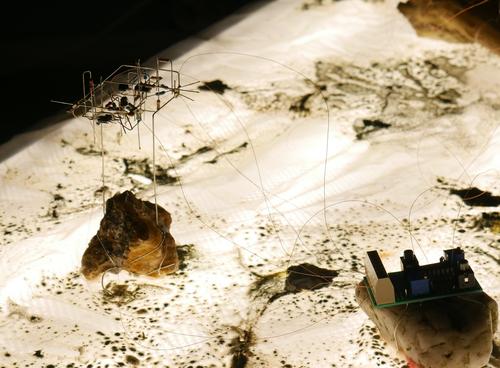
Aerials, on the other hand, were made to include microorganisms into the sound synthesis process itself, and all environmental variables at that – the opposite of what scientific instruments usually are. Aerials are open analog oscillator circuits that sound only in conjunction with liquid medium – media so permeable it non-selectively invites biotic and abiotic environment to enact upon sound generation. In the durational experiment Infected, microbes from the audience as well as site-specific mold and bacteria were “invited” to infest the Aerial synthesizer via nutritional agar. Unlike in sonification, that uses selective probes and data to drive sound synthesis, microbes on Aerials are in the sound synthesis process itself – to an atomic level. As the colony grows between resistors, capacitors and IC’s, it lives under condition of alternating currents– a constant electric potential cycling (oscillation) that does induce reduction and oxidation of various chemical species within the medium. It is a multitude of physical entanglements through electric charges, metabolism, vibrations and people who experience the work– all of which have reciprocating influences upon each other. The work speculates on a possibility for electronic-microbial junction, where microbes partake in the functioning of electronic devices. This translates to the music making process itself, “infecting” the sound, altering the voice and meaning that electronics mediate to us, humans.
The questions, experiments and framework that I present in this essay mirror some of the key aspects and inspirations for Micrbiophonics, yet the full scope of this research can be grasped in my thesis 20 and documentation accessed on my web page 21. From the beginning, the aim of Microbiophonic Emergences was not to obtain data and prove hypotheses, but to prise openings: suggest different perspectives upon thinking, reasoning and most importantly physically engaging with the microbial: through sound and all the other senses. Though sound (especially at the microbial scale) may seem miniscule and irrelevant, in our inextricably entangled planet 22, sound may play a distinct role on yet not understood perhaps evolutionary, proportions. Within the current reality of climate calamity, deteriorating ecosystems and rapid depletion of earth’s resources, these invisible relations are important to trace, as they help to build the foundation for a non- anthropo-centered perspective upon our world.
Bio
Adomas Palekas (LT) is a sound and bio artist who works with environmentally entangled sound practices. His current research focus is on circuits of extended phenotype – a creative practice that invites biotic and abiotic worlds to enact together in the process of sounding.
Bibliography
-
Cavicchioli, Ricardo, William J. Ripple, Kenneth N. Timmis, et al. “Scientists’ Warning to Humanity: Microorganisms and Climate Change.” Nature Reviews Microbiology 17, no. 9 (2019): 569–86. https://doi.org/10.1038/s41579-019-0222-5. ↩
-
Burton, Maria, Janina A. Krumbeck, Guangxi Wu, et al. “The Adult Microbiome of Healthy and Otitis Patients: Definition of the Core Healthy and Diseased Ear Microbiomes.” PLOS ONE 17, no. 1 (2022): e0262806. https://doi.org/10.1371/journal.pone.0262806. ↩
-
Merriam-Webster. “Sound.” Accessed April 21, 2024. https://www.merriam-webster.com/dictionary/sound. ↩
-
Liu, Chia Jui, Shih Che Huang, and Hsing I. Chen. “Oscillating Gas Bubbles as the Origin of Bowel Sounds: A Combined Acoustic and Imaging Study.” The Chinese Journal of Physiology (India) 53, no. 4 (2010): 245–53. https://doi.org/10.4077/cjp.2010.amk055. ↩
-
Pelling, Andrew E., Sadaf Sehati, Edith B. Gralla, Joan S. Valentine, and James K. Gimzewski. “Local Nanomechanical Motion of the Cell Wall of Saccharomyces Cerevisiae.” Science 305, no. 5687 (2004): 1147–50. https://doi.org/10.1126/science.1097640. ↩
-
Willaert, Ronnie G., Pieterjan Vanden Boer, Anton Malovichko, et al. “Single Yeast Cell Nanomotions Correlate with Cellular Activity.” Science Advances 6, no. 26 (n.d.): eaba3139. https://doi.org/10.1126/sciadv.aba3139. ↩
-
Kohler, A.C., L. Venturelli, G. Longo, G. Dietler, and S. Kasas. “Nanomotion Detection Based on Atomic Force Microscopy Cantilevers.” The Cell Surface 5 (December 2019): 100021. https://doi.org/10.1016/j.tcsw.2019.100021. ↩
-
Pelling, Andrew E., Sadaf Sehati, Edith B. Gralla, Joan S. Valentine, and James K. Gimzewski. “Local Nanomechanical Motion of the Cell Wall of Saccharomyces Cerevisiae.” Science 305, no. 5687 (2004): 1148. https://doi.org/10.1126/science.1097640. ↩
-
Rosłoń, Irek E., Aleksandre Japaridze, Peter G. Steeneken, Cees Dekker, and Farbod Alijani. “Probing Nanomotion of Single Bacteria with Graphene Drums.” Nature Nanotechnology 17, no. 6 (2022): 637–42. https://doi.org/10.1038/s41565-022-01111-6. ↩
-
Cees Dekker Lab, dir. TU Delft– The Sound of a Single E.Coli Bacterium on a Graphene Drum. 2021. https://youtube.com/shorts/DYWX16Orq4c?si=1IbkvCdol80lHUJu. ↩
-
Adamatzky, Andrew. “Language of Fungi Derived from Their Electrical Spiking Activity.” Royal Society Open Science (England) 9, no. 4 (2022): 211926. https://doi.org/10.1098/rsos.211926. ↩
-
Reguera, Gemma. “When Microbial Conversations Get Physical.” Trends in Microbiology (England) 19, no. 3 (2011): 105–13. https://doi.org/10.1016/j.tim.2010.12.007. ↩
-
Obolonkin, Victor, and Silas Granato Villas-Bôas. “Sonic Vibration Affects the Metabolism of Yeast Cells Growing in Liquid Culture: A Metabolomic Study.” Metabolomics 8, no. 4 (2012): 670–78. https://doi.org/10.1007/s11306-011-0360-x. ↩
-
Harris, Alastair, Melodie A. Lindsay, Austen R. D. Ganley, Andrew Jeffs, and Silas G. Villas-Boas. “Sound Stimulation Can Affect Saccharomyces Cerevisiae Growth and Production of Volatile Metabolites in Liquid Medium.” Metabolites 11, no. 9 (2021): 605. https://doi.org/10.3390/metabo11090605. ↩
-
Adadi, Parise, Alastair Harris, Phil Bremer, et al. “The Effect of Sound Frequency and Intensity on Yeast Growth, Fermentation Performance and Volatile Composition of Beer.” Molecules (Basel, Switzerland) (Switzerland) 26, no. 23 (2021). https://doi.org/10.3390/molecules26237239. ↩
-
Dai, Chunhua, Feng Xiong, Ronghai He, Weiwei Zhang, and Haile Ma. “Effects of Low-Intensity Ultrasound on the Growth, Cell Membrane Permeability and Ethanol Tolerance of Saccharomyces Cerevisiae.” Ultrasonics Sonochemistry (Netherlands) 36 (May 2017): 191–97. https://doi.org/10.1016/j.ultsonch.2016.11.035. ↩
-
He, Ronghai, Wenbin Ren, Jiahui Xiang, et al. “Fermentation of Saccharomyces Cerevisiae in a 7.5 L Ultrasound-Enhanced Fermenter: Effect of Sonication Conditions on Ethanol Production, Intracellular Ca2+ Concentration and Key Regulating Enzyme Activity in Glycolysis.” Ultrasonics Sonochemistry 76 (August 2021): 105624.https://doi.org/10.1016/j.ultsonch.2021.105624. ↩
-
Ingold, Tim. “From Science to Art and Back Again: The Pendulum of an Anthropologist.” Interdisciplinary Science Reviews 43, nos. 3–4 (2018): 213–27. https://doi.org/10.1080/03080188.2018.1524234. ↩↩
-
Holdrege, Craig. “Doing Goethean Science.” Janus Head 8, no. 1 (2005): 27–52. https://doi.org/10.5840/jh20058132. ↩
-
Palekas, Adomas. “Microbiophonic Emergences.” Institute of Sonology, 2024. https://sonology.org/wp-content/uploads/2025/04/Adomas-Palekas-Microbiophonic-Emergences-Sonology-Masters-thesis.pdf. ↩
-
Palekas, Adomas. “Microbiophonic Emergences Web Page.” https://www.adomasp.com/microbiophonic. ↩
-
Margulis, Lynn, and Dorion Sagan. Gaia and Philosophy. Portals. Spiral House, 2024. ↩