 Editorial
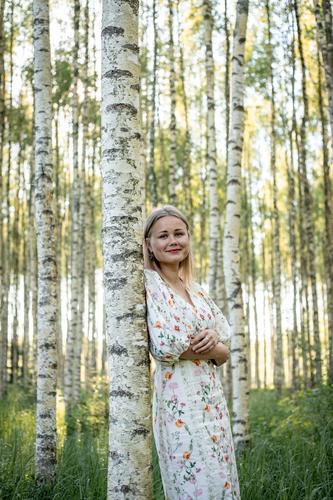
Sound art through the eyes of non-musical field biologist
“The sound setup might have been okay, but that off-key backing vocal… I hadn’t expected such an unpleasant performance,” he told me, as we stood in the cloakroom line for coats with the other listeners, a few of whom looked just as grumpy as he did."
“Really? But that burst of energy! Their eyes were burning!”
“They have to learn to sing first.”
“How lucky I am that I don’t have a musical ear…”
Such conversations between me and other people are not rare. I’m the kind of person who doesn’t notice what’s “wrong” with music, even when everyone else does. I simply don’t have that ability. I’m not proud of it, but maybe that’s why I sometimes enjoy musical performances more than others - imperfections don’t bother my mind. Anyway, as one popular quote says: it doesn’t matter what you don’t have - be happy with what you do have.
I will briefly introduce myself. My name can be found under the title of this page, and as it says there, I am a field biologist. Currently, I spend a large part of my life on the road. No, I’m not traveling around the world - I am just a PhD student who studies forest roads. For the past few years, I have spent my summers identifying plants and catching bees and hoverflies. Almost every fieldwork day, I get surprised looks from people driving by - what is she doing there in the ditch? I didn’t know before that people can turn their necks almost like owls - close to a 270-degree angle. When winter comes, I dig into statistical analyses to turn the data I collected into scientific evidence that might help us understand fundamental ecological processes in these very common but less-studied habitats. For my mental health, I have started practicing “bee combing,” which, by the way, also develops fine motor skills. Yes, you understood correctly. To identify the bees collected in summer, each bee has to be taken out of the preservation solution, dried, and brushed out. Otherwise, it is impossible to clearly identify the species. Imagine yourself after a shower - you also have to comb your hair. So, that’s a quick overview of what I do - long story short.
I know you might be wondering what someone like me - a person as far from sound art as you can imagine - is doing here. Everything began when a good friend of mine invited me to be a nature guide for two amazing artists, Pierce Warnecke and Matthew Biederman, who came to Latvia to create three-dimensional visual representations and near-field audio recordings of our country’s fragile ecosystems. I had never worked as a nature guide before, and even though I still have a lot to improve, I would say it’s not so difficult when you have to talk about something you’re truly passionate about.
Latvia may be a small country, but it is rich in biodiversity because it lies between the temperate and boreal zones, giving us species from both. During the short time we could spend together, it wasn’t possible to show the artists everything I would have like to. So, I had to select just a few pieces of our biodiversity - pieces that, taken together, could form a vision of what makes Latvia’s nature so special and unique. We visited the Veseta floodplain mire to see orchids, walked through an old boreal forest, listened to a forest stream running through Nāruža Devil’s Ditch, visited a Jaunāsmuiža veteran oak tree and a beaver’s kingdom, and stepped into the Palšu peat bog, where we tried jumping on sphagnum moss like a trampoline.
At each nature site we visited, I tried to point out a few key species - some protected and some not - but all with characteristics that artists could probably somehow store in their memory. For example, we went to the mire mentioned above to see the heath spotted orchid, a particularly ‘cunning’ flower species. It does not waste energy producing nectar as a reward for pollinators. Instead, it produces only the smell of nectar, which attracts bees. The bees arrive expecting food, but receive nothing - yet they still pollinate the flower. The artists also looked through a field microscope at the biodiversity they would not notice otherwise. Some moss species are barely visible to the naked eye, yet under magnification their shimmering, hook-like branch tips reveal a hidden beauty within a mire that at first glance can seem muddy and uninviting.
Everything begins with species. Their relationships with each other are what make nature what it is. In nature, species are like letters: when you put them together, you can read the story of a place like a book. Of course, those letters (species) we learned together were not enough for artists to be able to fully know our nature. Sometimes biologists need their whole lives to learn a certain group of organisms very well, and that is not the artist’s task at all. Their task is to form their own vision of Latvia’s nature into a piece of art, and my job was to find and show them those small diamonds of our nature to give their work additional value.
To be honest, that day I had no real understanding of what the artists were doing, even though they of course tried to explain it to me. I saw them taking hundreds of photos and placing microphones in strange places - for example, inside the bog water or so close to plants that, from the side, it looked like they were conducting an interview. That day I also looked at nature from a perspective I had never seen before. With sound-amplifying devices, the artists let me listen to the sounds of ant steps, water cycling in tree stems, and the voice of the stream underwater. One thing is to hear such sounds in documentaries; another is to hear them live. To see something as small as an ant and hear each of its steps at the same time reminded me of a feeling we often forget in our daily life - how wide the world is outside our minds. It was also interesting to see how other people perceive things for the first time that, for us, are just part of everyday life, and to notice which elements of nature the artists focused on.
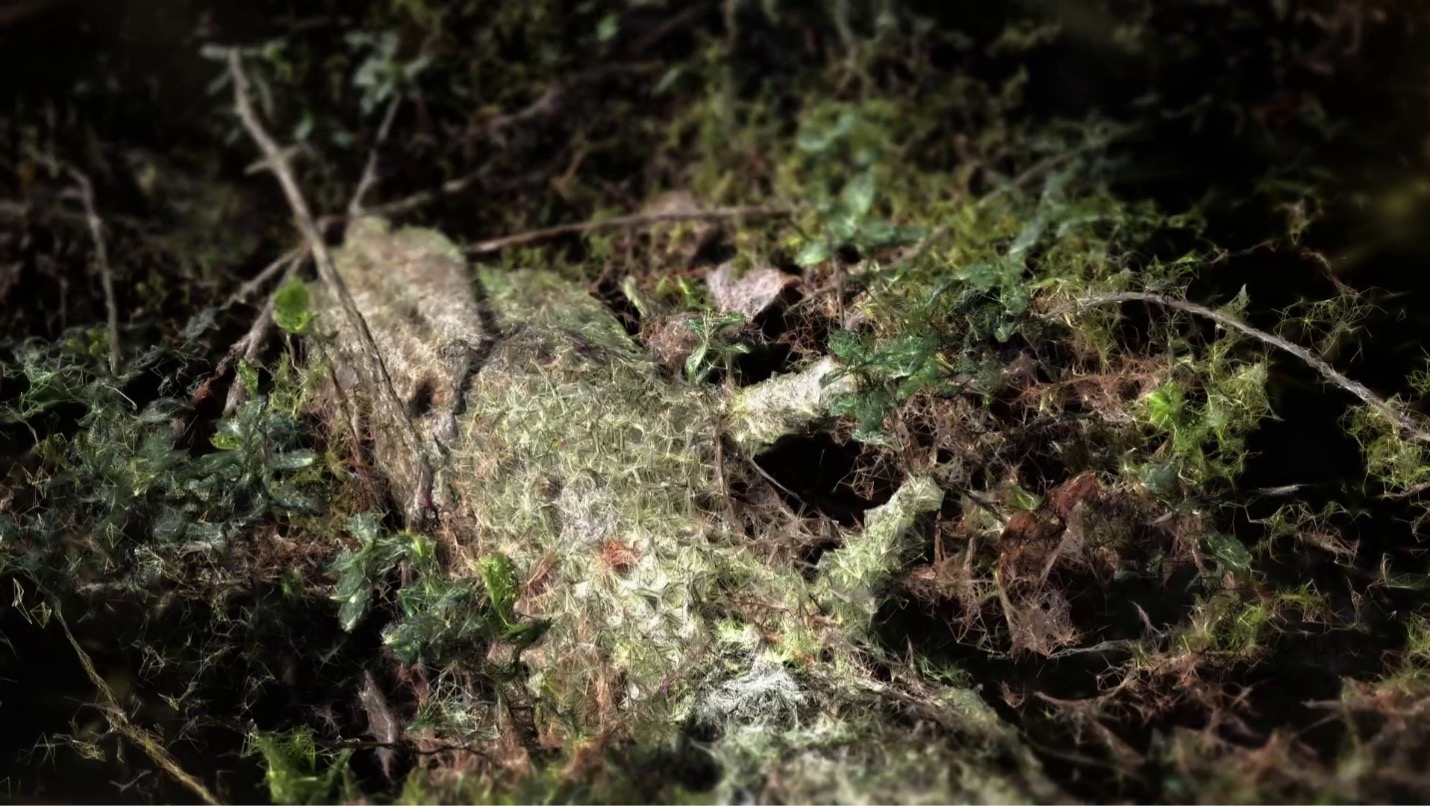
The project of Matthew and Pierce was called “Phytomorphic Topographies”1. In autumn, the project was presented as a live performance at the festival “Skaņu Mežs” - a gathering for adventurous music in Riga. I went there too, to see the artists’ vision of what they had experienced in Latvia’s nature. The performance was designed as a journey through Latvia’s nature at different levels - from large-scale imagery to human perception and beyond. Since I am not competent in this field, I will not go into detail about the technologies involved. The artists have described their performance comprehensively in an interview with Arterritory 2.
First, I really enjoyed the visual aspect - not according to any criteria, but simply because it drew me in. I felt the performance offered a perspective on Latvia’s nature that we cannot see with our eyes - a glimpse into its energetic level. No one knows exactly what it looks like, and maybe that’s good, because everyone can imagine their own vision. For me, the energy of every ecosystem is hidden in its biodiversity. The more species there are, the more energy blinks pulse through the ecosystem, and the more resilient it becomes. Imagine walking on a bridge made of net: the more threads it has, the stronger it is. If one thread breaks - like when a species disappears - the bridge still holds. But if there are only a few threads, the whole structure can collapse. That is what makes forests, swamps, bogs, and other ecosystems resilient. And in this performance, through the visual experience, I saw that energetic connection as the main unifying element.
That evening, I also stayed to see other artists. Perhaps it might sound a bit exaggerated, but the festival showed me a part of the art world I could never have imagined existed. I was thrown out of my art-perception bubble and thrown into something I had never seen before - in different aspects that I will explain further in this paper.
One of the most surprising moments for me was the performance of British improvising saxophonist John Butcher. To be honest, I saw his saxophone playing as if he were touching the instrument for the very first time in his life. I know that people who are into this type of art might think that I don’t understand anything - and they are right. The kind of art I saw in every performance that evening is very different from what I am used to. It cannot be compared to the music I used to listen to. It felt like a different world, with its own rules.
The second thing that surprised me at this festival was the audience. The whole hall was almost completely silent, even in the very back where I was standing during some performances. I know it may sound a bit funny, but I was surprised that people really listened to the artists. At the standing concerts I used to attend, this is a huge problem. That’s why I always try to go to the front rows - not because I want to be as close to the artists as possible (which, of course, is also nice), but because in the first rows there are usually people who really care: who came to listen and enjoy every second of the concert as I do, not to talk with others about their life struggles or to taste every drink available. I don’t want to be that grumpy person complaining about others, because maybe I just have a different perception of enjoying concerts. What also surprised me were some people who were dancing at the edge of the hall, not caring what others thought, completely immersed in their own world. Their movements reflected a feeling of flying through the infinity of their own minds. It was not because they were under the influence of alcohol or anything else. They simply looked like they were enjoying the moment.
But I didn’t know that this festival would be just the beginning of a month in which I would unintentionally attend three more experimental art events - more than ever before in my life. It felt as if the Universe had decided to send me on a journey of experimenting with myself. It continued at the Riga International Film Festival. I bought tickets to the Short Film International Competition but somehow didn’t notice the word “experimental”. Before this, I didn’t even know such a movie genre existed. The festival program includes a wide range of formats and approaches, and for someone without previous experience of experimental cinema, it is not always immediately clear what to expect from this movie genre. That evening, I watched six very different experimental short films. One showed a naked man from different angles in a cave for the entire movie (Cave Man 3), another took me into time-bending distortions (Centre of the Spiral4). But the common thing in all of them was that the plot was very hard to understand - at least according to my previous idea of what a plot should look like. My brain simply didn’t know how to watch such movies, how to understand them, or how to reflect on them.
The next came a Tommy Cash concert - again, not really on purpose. Before the concert, I only knew one of his songs, which made me feel so amused that about half a year ago my friend and I bought tickets just for fun. But once again, I ended up in experimental music, as he represents not only hip-hop but also the experimental side of the genre. Even though the performance was very bright, I somehow perceived it more as chaos on stage, and I couldn’t make a connection in my mind between the visual and musical experience.
My last experience that month was the rotoscoped comedy-horror animation Dog of God 5, written and directed by brothers Lauris and Raitis Ābele. It is not classified as experimental animation, but for me it was still something I had never seen before. Compared to the short films, here I even found something similar to the kind of movie plot I am used to - at least in parts of it. And to be clear - I never watch horror movies, so once again I was thrown into a strange world where my mind struggled to process the experience. I remember someone telling me during the “Skaņu mežs” evening: sometimes you may not like a performance at all - and then it becomes interesting to discover how much you can dislike something.
All these events threw me out of my artistic comfort zone. And recently, I finally attended a casual concert - the kind I used to go to before. It felt like a strong contrast. Before the gig, I had this thought in my mind that I was finally returning to my roots and to who I am. Even though the evening was really nice, later I realized that I was at a concert where I knew almost all the songs, in a concert hall I had visited before, with a band I had already heard live. I somehow realized that I was just repeating myself again and again. It wasn’t because I had already started to get used to a different kind of art. It was because that evening I didn’t take a step out of my comfortable, warm emotional world. But again, the Universe is much bigger than our inner world. Going to a festival where each artist and each performance is something you experience for the very first time is a completely different feeling. Sometimes it is uncomfortable, but I guess that’s because our world is expanding and our boundaries are moving on. Even in daily life, all changes in us come with some difficulties. There’s a reason why psychologists say that if something isn’t difficult, then the changes in us might not be permanent.
For me, *Skaņu mežs” and the other events were an experience where you meet a part of yourself you have never met before. And it was not always about bright emotions or being confused about who you are. It was not about a life-changing experience. Not like that. It’s more like meeting someone for the first time - but the difference is that this person is inside you. And you just stand next to each other, feeling this awkwardness - this realization that there is much more unknown space within yourself than you ever imagined.
When I am writing this last paragraph, it’s a sunny day outside my window - very unusual for Latvia in November, which is the cloudiest month of the year. From time to time, a few sparse clouds drop some snowflakes. Even though I can’t call it the first snow, as these flakes are very few and melt as soon as they reach the ground, it still makes me feel something special. I believe that even the smallest experiences and feelings enrich us, and I also believe that within us - within you and within me - there are already all the answers to life’s big questions. These answers are not hidden in books - they are within us. But it is hard for us to find them if we don’t feel ourselves and the world around us. Probably, artists who read this might see my thoughts as a bit naive. But I just want to say to each artist: keep doing what you are doing. Because you are doing something very important. You make people feel.
Bio
Līga Pentjuša (LV) is a research assistant at the Latvian State Forest Research Institute “Silava”. She spends her summers identifying plants and catching pollinators, and her winters turning field data into scientific evidence. She is also a PhD student whose work explores forest road verges as habitats and the biodiversity of less-studied ecosystems. Interested in ecology and how people perceive nature around us.
References
-
Biederman, M. Phytomorphic Topologies. Accessed November 1, 2025. Available at: https://www.mbiederman.com/Phytomorphic-Topologies ↩
-
Leitholde A. Diving into “Phytomorphic Topographies”: Exploring Latvia’s Fragile Ecosystems Through Sound and Vision. Arterritory. Accessed November 1, 2025. Available at: https://arterritory.com/en/visual_arts/interviews/27697-diving_into_phytomorphic-topographies/ ↩
-
Cave Man (trailer). Available at: https://www.youtube.com/watch?v=XUBSk0EzKUg ↩
-
Centre of the Spiral (trailer). Available at: https://www.youtube.com/watch?v=xMriY8r6tHA ↩
-
Dog of God (trailer). Available at: https://www.youtube.com/watch?v=6grA\_xBpwjY ↩