 Editorial
The Simpler, the Better
Down the Gauja – From Arduino to a Wire Coil
Sharing the experience of the Strenči Sonification Station
We arrive in Strenči1 with the goal of observing rather than showing; we ask more questions than we speak; we educate ourselves rather than teach... Such is the premise of the Strenči Sonification Station2. Although it all began with field recording classes at the Strenči Primary School, which Maksims Šenteļevs3 and I led once a week, teaching a small group of schoolchildren field recording techniques4, from then on, we have simply been filling empty space. I mean, at the school, we were assigned an empty reading room in the library. Jānis Pētersons, the head of the town, showed us several vacant spaces around Strenči that we could fill, but he knew from the start which one would suit us best—and he was right. We settled in the very center of the town in a former small clinic (the clinic now has renovated premises across the street), evidenced by a hole in the floor of one room for a saliva ejector tube. Apparently, a temporary kindergarten was also located here once, which would explain the old children’s lockers with colored letters on the doors. We will still try to adapt them to our needs. The town gardener quietly collected the seedling pots that covered every surface on the first floor, and we slowly began to inhabit these rooms. This is a collaboration project between the Orbīta collective and the Valmiera Municipality, which started with the development of the European Capital of Culture proposal and has continued for several years. I am in charge of the Strenči Sonification Station (SSS), which we create, plan, and fill together with Maksims. Below, I will describe our journey so far, omitting most of what we’ve achieved so as not to turn this story into an art project portfolio. If this path, which we continue to follow, must have a narrative arc, then I currently see it as a gradual reduction, a self-limitation—a movement from the complex and "smart" toward the singular and direct, ending in shocking simplicity.
While leading classes at the school, the first realization about technology and the periphery arrived: there is no periphery. Modern technology is characterized by connectivity, networking; in that sense, we—along with small-town pupils, or Soundcamp from London and the Aporee global sound map5—are in the same network. That is the difference from the technologies of previous eras, which had to be "distributed" or "implemented" from the center to the edges. Nowadays, you don't arrive with a camera box, chemicals, and acquired knowledge6; instead, you connect to the storehouse of know-hows on the spot and participate in an equal global process, enriching the same clouds as people on other shores. In a network, what you do here is just as important as what happens in other parts of the network, because there is no center anymore. The schoolchildren have the same internet you do. As a result of this constant exchange of ideas, concepts, methods, and approaches, the world truly seems to have become more homogeneous; people now have to explain less to each other, although the geopolitical events of recent years prove there is still a long way to go in this direction.
The global infrastructure network is quite uniform and covers Strenči as well: electric vehicle charging stations (two, even), public WiFi, water and heat meters that transmit their own data, an automated boiler house, a treatment plant, a railway crossing, town-wide video surveillance, a self-service post office, and M2M solutions in almost every electrical cabinet... The only difference is that many of these micro-industrial and urban objects are much more closely integrated and submerged in living nature, with which, it seems, they may one day merge. We observed and captured this while working with videographer Andrejs Strokins on a series of "video-paintings" with an expanded field recording track.
In Strenči, we engage in listening and sound harvesting. We obtain sound in a wide variety of ways, using diverse techniques and practices, then record it to discs and store it in clouds. Over these three years, we (and our guests) accumulated quite a few files, and sometimes they find further use in exhibitions, performances, and other sound-art projects. The equipment and techniques we use are aimed at making the observed environment and its manifestations audible. "Making audible" has two meanings for us: 1) the most direct—amplifying or shifting sounds inaccessible to human hearing, or converting other types of environmental fluctuations into audible sound (sonification); 2) the second meaning relates to refreshing and highlighting habitual, "worn-out" sounds, focusing dulled perception through listening practices, or actualizing the sonic dimension of a specific location—exploring space through sound.
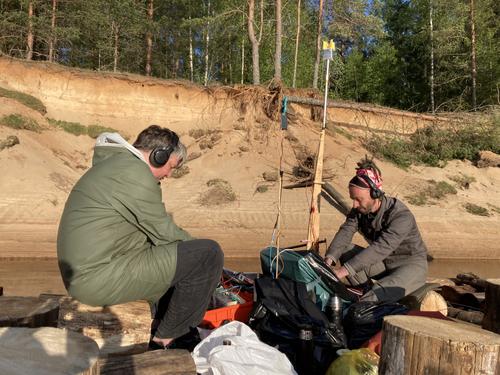
The reference point, the start of the new season every May, is a journey down the Gauja River with the Gauja Rafters7. These three expeditions and what we do during them also mark the change and evolution in our approach to sonification. The first time (2023), you don't quite know what to expect and you bring everything you have in terms of equipment. Most of it turns out to be useless. You try to record environmental data (humidity, insolation, temperature, wind direction and speed, channel depth, GPS coordinates, etc.) to later convert them into sound or control voltage for other sounds. We had many sensors from standard Arduino kits and more advanced ones; the whole way, we sorted, connected, and adjusted them. But in practice, the most productive tools this time turned out to be good old hydrophones and piezo pickups simply attached to the burnt wires holding the raft together. You record conversations and songs. Even the water under the raft resonates, and people can be heard through the hydrophones. Meeting anthropologist Ieva Vītola, her interviews with old rafters also end up in your materials, along with the book Gauja Rafters. Returning to shore with such a rich catch, you are thrilled by these discoveries and the cultural shock of experiencing a world previously hidden from you. But while preparing the soundscape for an exhibition, you realize that playing it back on "normal" audio equipment, unmediated—i.e., directly through speakers—is impossible, because this sound material requires "materiality," "tactility"—a filter of matter. Together with Jēkabs Voļatovskis, you create special equipment for it: three-way stereo vibro-speakers that transmit sound from wood, metal, and glass surfaces, while a processed piece of granite, resembling a tombstone, serves as the subwoofer. Sound becomes sculptural, presented to visitors in a dark room as the only dimension of the environment. To maintain its belonging to reality (remembering that the soundtrack mostly consists of field recordings), only a one-inch screen under a magnifying glass is left, showing a video filmed from the raft—the bank of the Gauja sliding past the camera—as a visual verification of the sound’s "truthfulness."
Summarizing the first year's experience, it seemed that the second step in the development of the idea would be to design an Arduino-based device ourselves. This would allow us to record signals from any environmental sensors (essentially voltage fluctuations) into log-files, with the possibility of playing these files back later for sound control as CV and/or MIDI. For example, we could convert our observation of the raft into sound—how it moves not in the middle of the channel, as a neophyte might think, but like in a slalom, from one bank to the other to navigate the river's bends with its 80–90 meter long tail. In this sense, changes in the distance to the right and left banks are just as important a characteristic of the raft's movement as the current speed and the changing river depth, if we want to describe this journey later in sound. Previously, while developing the sound and poetry performance Echo Echo with Orbīta, we had already created several devices that converted real-time electromagnetic environmental measurements (background radiation, WiFi and GSM ether load, fluctuations in the 220V power grid, etc.) into a variable CV signal (+/-5V) that controls modular synthesizers.
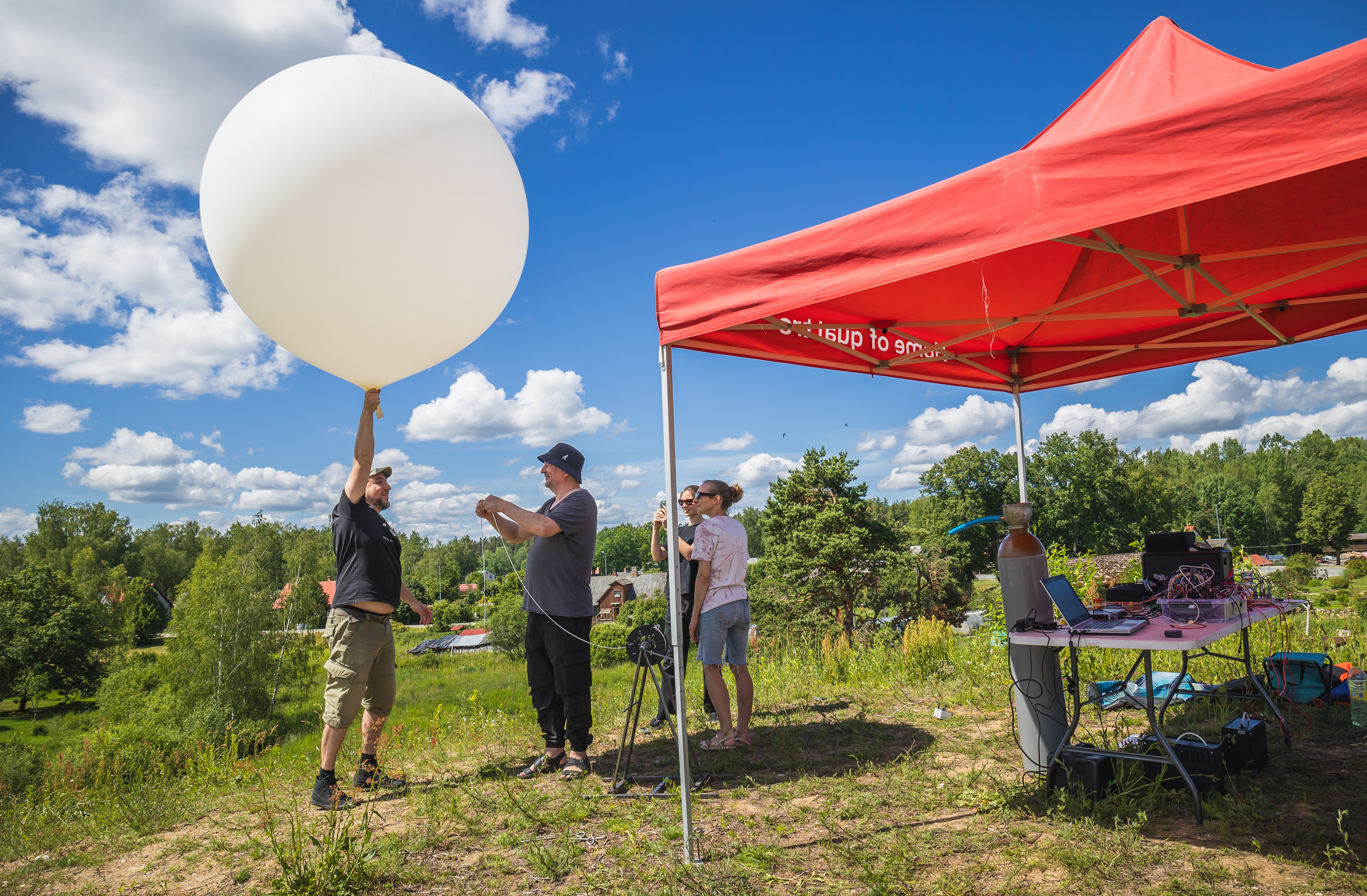
In the case of the Strenči sonification, we wanted to expand the number of sensors used (as many as possible, as the instrument must be universal) and create the technical capability to record that data stream, as well as process and control its playback (scaling, slowing down/speeding up, etc.). A very early device prototype (protected from water in insulated plastic pipes) and a test version of the software with several sensors connected to an Arduino went on the second expedition with the rafters, but did not survive the harsh conditions on the raft. Our meager knowledge of microcontrollers was not enough to bring it all to life on the raft deck. It was a failure that freed up a lot of time for the rest of the journey. Of everything I could still work with, I only had a small, untunable all-band radio, whose reception range depended only on the length of the connected antenna. I replaced the antennas with pieces of wire from our tool kit. For most of the trip, we were outside commercial broadcast coverage, in the forests of Northern Vidzeme, so the received signal mostly resembled white noise, but there were also known fluctuations within it. And then I noticed that these fluctuations were directly related to our movement down the river, and in that sense reflected it no worse than other sensors. I thought about this as the season continued, when in several workshops together with Paula Vītola (@Mosquitonarium), Rostislavs Rekuta (@Sound Meccano), and Sofi Zaiceva, we studied the sonic potential of so-called "free" energy (e.g., wind, water, sun...) hidden in the natural unevenness and fluctuations of these sources. One of the practical experiments involved raising a long antenna (that same metal wire) with a big helium balloon. Upon climbing the Strenči School hill, we managed to unwind about 150 meters of wire from a coil, ground it, and record about one hour of the variable voltage this wire generated—gathering it from the atmosphere's electromagnetic field. Technically, it was even more primitive than the all-wave radio on the raft, but sonically it manifested as chaotic crackles (similar to those heard on an old scratched record or in an open-flame fireplace burning dry wood) against a background of white noise. Yet in this cosmic chaos, one quite regular "pumping" signal was present, obviously anthropogenic, most likely created by a nearby mobile communications tower. Here I was convinced once again that a simple wire describes our location and environment just as expressively as a set of many complex sensors.
Although later that year, the SSS's guest artists and I created many works unmentioned here based on more or less advanced technologies—isolated recordings of flying insects with optical microphones (with Paula Vītola), ambisonic multi-channel recordings exploring the acoustics of various architectural objects (with Maksims Šenteļevs), autonomous sound objects in the urban environment (with Jēkabs Voļatovskis), a pirate FM radio station for storytellers on the raft in SSS's third season (with Agita Lapsa), and several others—the feeling that a piece of unwound wire is a solid, radically simple, and universal answer for observing the environment through sound continued to grow.
At the end of the third season, Orbīta received an invitation from the Üle Heli festival (https://ule-heli.ee) in Tallinn (Estonia), which involved a collaboration with Raul Keller (Lokaal Raadio) and seemed to fit these radical premises very well: the exhibition had to be created very quickly with minimal material costs. We asked the organizers to purchase 5–6 coils of lacquered brass wire of various diameters. The result was the "intuitive antenna" sound installation Same yet Different—several coils were used to wrap or cover objects and surfaces in the space: chairs, a tile wall, ceiling structures, and a supporting column in the middle of the exhibition space. The length and shape of the antennas were not calculated but were created based rather on the desired visual effect. Then, with the addition of a small capacitor or even without one, both ends of the wire were directly attached to a TR audio contact. The electromagnetic background each antenna gathered was filtered by selecting that part of the spectrum/range where the dynamics were more noticeable; then a threshold gates were set so that the sound wouldn't be annoyingly continuous but would "break through" in a chaotic staccato only upon reaching a certain amplitude level. Based on our own subjective taste, other sound processing effects were also applied. We ended up with a self-playing "ensemble" of four antennas, featuring a bass, a background drone, a vocalizing soloist, and a lead instrument. Raul Keller broadcast this ensemble with small FM transmitters, and they also influenced the behavior of our antennas, smoothing the signal and blocking out more distant signals. I was satisfied, and I would like to repeat this disarmingly simple solution again and again—in other locations and with a different signal processing approach…
With this, the journey from relatively complex digital solutions to the wildly simple and analog electricity of the ether has been completed. Returning to Riga, I remember that we have actually always been at this point, because the first outdoor sound installation we exhibited in Strenči, at the project's opening event, was the antenna grove From the Air, which accumulated and condensed the electricity of the ether.
Well, okay, maybe it wasn't yet so radically simple and was born from the realization that radio waves are just energy transmitted through the air that antennas can collect as electricity, much like plants collect dew. In any case, perhaps we've just come full circle and are back where we started…
Take a long piece of wire (10–50 m), give it any shape you like by wrapping it around something, screw or solder both ends of the wire to a TR audio contact (you can add a small capacitor for a more efficient result), plug the jack into a mixer or amplifier, turn your intuitive antenna to "tune" it, tune yourself as well—your audio fireplace for observing the surrounding environment and your inner depths is ready.
Strenči, December 2025
Bio
Artūrs Punte (LV) is a sound artist, poet, and translator. A member of the Orbīta collective, he specializes in contemplative and environmental sound art, creating numerous site-specific sculptures and performances. He graduated from the Maxim Gorky Literature Institute in 2004 and studied Graphic Design and Horticulture. Punte curated cross-disciplinary projects like “Riga Poetry Map” and “Strenči Sonification Station.” With Orbīta, he has released several almanacs, audio albums, and video collections. He has authored four poetry books, with work translated into over ten languages. He participated in the 2023 Skaņu Mežs festival as part of the tekhnē project with the installation “From the Air” and the performance “Echo Echo” – both works use electromagnetic side of the environment to generate and control sound.
-
A small Latvian town (\~1000 inhabitants) in Northern Vidzeme region, on the banks of the Gauja. ↩
-
Strenči Sonification Station – is a long-term project initiated by the Orbita collective (www.orbita.lv) in 2023 curated by Artūrs Punte and focused on contemplative forms of sound-art, observing natural, physical, and social processes and their embodiment in sound and listening. The project is supported by the Valmiera Municipality, the Latvian State Culture Capital Foundation, as well as institutions and individuals from Strenči town. ↩
-
Sound-artist, author of the project "Bērnu rīts" (www.bernurits.com). ↩
-
Project of the Latvian Centre for Contemporary Art, "The Artist is Present" (https://artistispresent.lv/). ↩
-
International sound-artist communities (https://soundtent.org and https://aporee.org/) with which the Strenči Sonification Station collaborated a bit over the years spent in Strenči. ↩
-
More than a century ago, Dāvids Spunde established a photo studio in Strenči; over time, the studio's archive of glass negatives, capturing small-town life in the interwar period, became an important historical testament: https://www.valmierasnovads.lv/unesco-latvijas-nacionalaja-registra-pasaules-atmina-ari-strencu-fotodarbnicas-kolekcija/ ↩
-
A local community that preserves the historic craft of timber rafting (www.facebook.com/GaujaRiverRafters). In some sense, being a Gauja rafter is like being a Texas cowboy – it’s a lot of fun, involving a certain style of clothing, harsh humor, as well as a special ironic manner of speech and other carnival elements. The raftsmen's official motto "Let the raft go its own way" is in many ways consonant with the contemplative concept of the Strenči Sonification Station. ↩