 Editorial
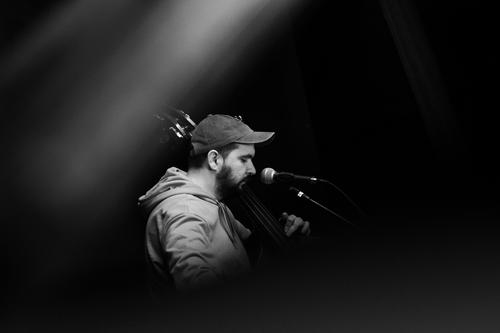
On the Transmissibility of Connection and Improvisation: Listening with Os Heróis Indianos Romanos Africanos
In early 2016 I replied to an open-call from OUT.RA, calling for local musicians to assist Anla Courtis in a workshop/residency in Barreiro with the vague ambition of developing new ways of musical expression alongside people with special needs. Aside from a complete trust in OUT.RA, something drew me to this opportunity to further delve into ideas that were already haunting me. I ineloquently tried to explain why I found communication to be the attribute I valued the most in music and how norms limit said communication. I knew better back then to let others speak for me and finished that application email with the same Watchmen quote I started this text here. There is no ordinary person. The myth and ideology of “normalcy” is a killer. It kills joy and creativity, and figuratively and literally tries to kill the differences that enriches our biodiversity. And at that time, I didn't even know I am autistic.
Growing up in a conservative family in a small town, I started discovering and understanding myself through music, namely through classical training. Growing up, every time a jazz musician came to my town, there I was, with a thirst to broaden the world I knew. As soon as I came to Lisboa to pursue the path expected of me – university, job, marriage, family – I quit classical music training and enrolled in the jazz school every jazz musician I workshopped with told me I should join. It was an eye-opening experience in music theory but those narrow ideas of freedom, harmony and improvisation didn't feel right to the Pharoah-Sanders-idolizing 18 year old me. I quit jazz school soon after.
I was becoming more demanding, confronted with the amazing expressions being made right under my nose. I was lucky to relish in the best music in Lisboa at that time. Weirdos like Rafael Toral, Sei Miguel, Nuno Torres or Manuel Mota were hugely influential in the beginning of my journey of self-knowledge and made me feel like I was in the right moment at the right time.
At that time, it was also through music that I got politicized. Some of the places I could find this music were also promoting books, conversations, films or simply a way of living that challenged capitalism’s norms. Music was something I was more versed in, but back then I realized I was mainly looking for a place and a people to fit in with.
I found that place and people in what might have been my most overwhelming learning experience. It was in MIA, Atouguia da Baleia's Improvisation summit / festival. MIA started with Paulo Chagas and Fernando Simões, two friends who began playing brass instruments together a long time ago in their hometown's marching band. Later, after the Portuguese revolution, when foreign music became more accessible, they went all-in into prog rock, which was a gateway drug to avant-garde and later free improvisation music.
Being generous bon vivants, they sure knew that challenging music is like a good meal and wine: a lot better when shared with friends. So, they started inviting peers to their hometown of Atouguia da Baleia for an annual meeting, a mainly musicians-to-musicians festival where most of the bands were sorted out randomly. In 2012, for their third edition, they opened up and called for other participants to join. I found the call-out in a niche literary punk facebook group I was in and readily applied.
That first weekend spent with “serious” erudite adults playfully exploring unconventional ways of producing and organizing sound and silence destroyed a lot of what I thought I knew.
As it is always, that deconstruction was a process. In the beginning, I was very much trying to prove myself among my elder peers. But, unlike other social dynamics I was accustomed to, this felt almost effortless. For the first time, I felt I could rely on my intuition. Don't get me wrong, during the communal meals or any other moment without a concert to pay attention to, I was mostly mute and by myself. The nature of the encounter, nonetheless, made me befriend people that since then became life partners in crime, such as Yaw Tembe or Monsieur Trinité.
The more I know about neurodiversity, the more I recognize in MIA a temporary autonomous zone where people have conquered the right to explore the expressivity of their quirks by listening to their equals and learning together.
I found the same temporary autonomous home while being part of that workshop/residency with Alan and my soon-to-be friends from NÓS. Despite masquerading hierarchical roles — Anla being the pretend teacher, me and André Neves (and, since 2023, Leonardo Bindilatti) the pretend assistants, and everyone else the pretend participants — it was immediately clear the methodology would be as horizontal as possible. We would be making music together, as peers, and conquering acceptance by learning how to deeply listen to each other.
Pauline Oliveros coined the term deep listening the year before I was born. It might now be common sense among music enthusiasts but, even if we can trace a lineage of practices that precede the moment Pauline changed the intonation of her accordion, there was a recent past where that idea was yet to be named. Paraphrasing her, deep listening goes beyond hearing: it's an exploratory way of being, fostering empathy and harmony through attention. Besides being an arguably mandatory skill for a free improvisation musician, Oliveros expands the idea of deep listening to a whole perception and interconnectivity of reality. If reality is vibration, then listening is how we dance with it.
It is no surprise Alan Courtis became a big collaborator and apostle of Pauline. The approach he preaches is one of respect, curiosity and harmony. Not the harmony you can learn in classical or jazz schools, but the cosmic attentiveness one can look for. Something you cannot teach but keep on learning with your surroundings.
In that vein, there was never music or improvisation being taught during these residencies — or anything else, for that matter. We have drums, guitars, keyboards, microphones, percussion, etc., and we improvise together.
NÓS is an “organization of parents and technicians for the integration of the disabled person,” or so says their official name. Mentally disabled is the term used to perceive these people in Portuguese culture.
About three quarters of the people who spend the days there live with their families. The other quarter makes NÓS their full-time residency. They're adults of all ages and all kinds of sensibilities.
Leninha is a true punk rocker. She never takes an approach to an instrument for granted and often finds unique ways of playing, questioning, for instance, why should hands be like that and not the other way around.
Valdir spends most of his free time dancing to his own brand of K-pop girl’s group TikTok choreographies, and often gets anxious about singing, ranging from great enthusiasm to shyness. But when he finally picks up the mic, he always delivers joyful anger roaring queercoded chants.
Maria Inês likes singing in duets with Valdir. She has a neverending collection of popular songs in her head constantly, and has a predisposition to mash them up in Frankenstein’s monster's contagious tunes. Most partners she sings with follow her lead, but I believe she prefers to team up with Valdir, because he both indulges her and leads her to more abstract places where she can freely let loose.
Sandro mimics the behavior of that which would seem to give him credibility, often pretending to be discussing on the phone as if stock broking. Aside from being a guitarist and vocalist with a lot to say, he prefers the intellectual prestige the keyboard seems to represent. From the top of the keyboard he likes to conduct his colleagues, telling them what and what not to do.
José Boga is an old school crooner. He has the gravitas of an elder artist who doesn’t need to do much, because his journey speaks for him. He also writes. His body no longer keeps up with the demanding physicality necessary to play most instruments, but I'll always remember his poem, which he sang in the concert we played in 2020, where he goes to another planet, “for here on Earth it is of difficult understanding.” Elsewhere, on another planet, people might be more like him.
I can't remember the name of the Italian musician that used a filled travel briefcase as her instrument in an edition of MIA. In front of a microphone, improvising with others, she would pick objects from her bag, one at a time, and make sound with those that did and hold the ones that didn’t in front of the microphone, such as a photograph, for instance. But I sure remember Tânia's name, and her own brand of conceptual art she performs at every music session or concert, comparable to that Italian musician. Whenever she arrives, always dressed in full red, Tânia comes to me to ask for “her” red drum. She doesn't play it. “Tomorrow I'll play it,” she says every day. She never wavers in the performative role she set for herself, holding the red drum in her lap for the whole duration of the rehearsal or show.
Miguel never went to one of our shows because his family can't or won't take him there. He sings with the energy of a football hooligan, transforming every song he's part of into a punk anthem. He gets frustrated when I don't understand what he's trying to communicate. Sometimes a colleague of his will aid with a translation for us, and most of the ideas he wants to share are about how much he loves to listen to people singing sensitively, such as Daniel, a colleague with cerebral palsy and one of Miguel’s favorite singers.
I didn't see Sérgio the last week we spent in NÓS. He has been gradually participating less and less in our music residencies. His too-cool-for-school attitude made him a great disruption wildcard during the band’s first years, seldom doing what you expected. If he started a song appearing as a vocalist in front of a microphone, he might delay any kind of interaction until rapidly snatching a drum from another musician, banging loudly until the rest of the group starts following his lead. At that moment his job was done and, refusing to participate in anything constructive, he'd leave the stage abruptly mid song. Our last interaction was probably him mocking me, saying that I should be crazy if I thought he would play anything.
Francisco was only present in the first residency we did, but his influence will always be felt in the core identity of the band, namely our name, a creation of his: Os Heróis Indianos Romanos Africanos [The African Roman Indian Heroes].
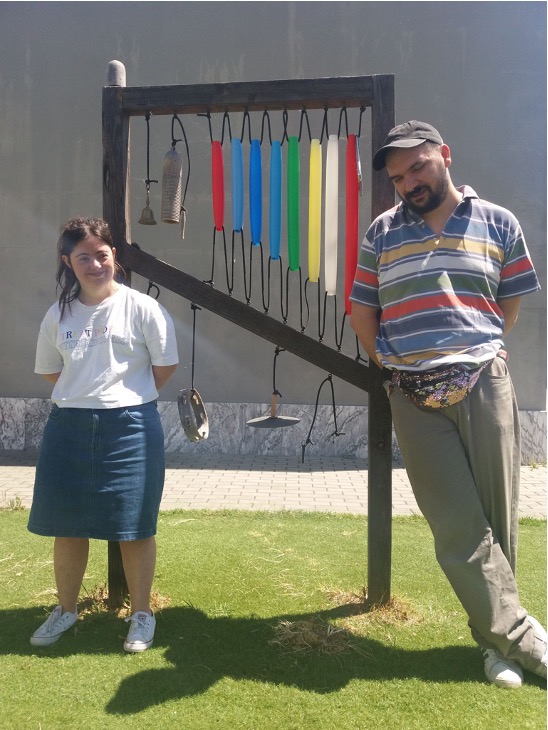
Ana Patrícia, whose stage name is Ticha, is a master of subtlety. Alan described her as the “fado Diamanda Galás.” She can delicately explore any instrument she uses, but it's her singing that's truly amazing, often on a time-suspended continuous mantra with microtonal variations. The fact that she's non-verbal gives her singing a whole new layer. I truly resonate with her expression and – while also speaking with her parents and NÓS – invited her to start playing in a duo with me, outside of these residencies, and I'd go to the organisation once a week for us to keep exploring our collective expression. We've already travelled to Sin Límites festival in Oviedo, Spain, and recently recorded an album with Ukrainian electronic musician Khrystyna Kirik during an artistic residency.
Those are just the first names in a list I wrote but now feel it might be too long. It would probably drag the text too much if I kept on with this ungrateful exercise of trying to praise and characterize countless other people in a few sentences, companions like Flávio, Mariana, Renildo, Luís, Paulo, Mário, Catarina, Samir, Jorge or Samuel, just to name a few.
A few years ago, I was invited by a music festival in the north of Portugal, ZigurFest, to replicate the work we do along with OUT.RA and NÓS with a similar organisation there. The band born out of it, baptized by one of the members as Tribo Improviso, was a success and gained a life of its own, doing two other concerts a year since their debut in the festival. Besides that, the festival kept on challenging Tribo Improviso to present new artistic expressions. Last year we presented an hour-long movie filmed and performed by us with the same dadaistic principles of connection as when playing music. This year, there’ll be an exhibition of paintings completed in several layers of attentiveness, where anyone could continue paintings started by their partners whenever they felt they’d have anything else to add.
Many of my creative partners who live within institutional settings navigate a world that often excludes or overlooks them. While society may marginalize them, their lived experiences foster unique forms of expression and communication. Freed from the performative pressures of the "ordinary," they create with raw honesty, unburdened by conventional expectations.
Their environments also cultivate profound adaptability – whether through symbolic gestures or nonverbal connection. Despite physical, cognitive, or communicative differences, they develop rich, nuanced ways to engage with one another and deep listen. Their creativity isn’t defined by limitations but flourishes in spite of them, revealing the resistance and ingenuity inherent in the act of expression.
My perspective greatly evolved during the last nine years, since I initially replied to OUT.RA's open call saying I found communication to be the attribute I valued the most in music and how norms limit said communication. I can now say with assurance that brutal honesty and deep symbolic communication are the two characteristics I value the most in artists and are also two arguments on why I feel so blessed to have creative partners such as in Os Heróis Indianos Romanos Africanos.
In her 2015 seminal book, The Mushroom at the End of the World: On the Possibilities of Life in Capitalist Ruins, anthropologist Anna Lowenhaupt Tsing proposes new ways of rethinking progress through interdependence. By focusing on matsutake (a mushroom that thrives in precarious conditions and is very valued in Japan) as well as the people who pick them in the wild, Tsing manages to paint a poetic metaphor for all forms of life improvising in a damaged world. There's an interlude chapter where she follows different mushroom pickers in what she describes as a forest dance. These rare mushrooms grow underground, and in order to find them, you need your full attention, rely on your senses and “more than senses.” The best way to find matsutake, she argues, is to look where one has found it before. It would be impossible to catalog all those places in the middle of nowhere, which denotes the limits of transmissibility of that type of knowledge. One simply remembers “the angle of a leaning tree, the smell of a resinous bush, the play of light, the texture of the soil” in a kind of memory that “requires motion and inspires an intimate historical knowledge of the forest.”
I find this mushroom picking description to be the best depiction of cosmic attentiveness improvisation, a kind of memory that requires motion and inspires an intimate historical knowledge of all of us.
Is this knowledge transmissible? Yes and no.
Some years ago, I worked at a call-center, barely trying to sell health insurances to the unsuspecting people on the other side of the line. In the brief company training I was taught active listening skills. It was very easy to learn how to demonstrate care and personalize the conversation, bringing back stuff previously said by the other person. In order to work in a call-center, one has to learn improvisation. Music schools also teach improvisation.
Maybe two or three years after leaving classical school, I wrote to the professor of improvisation that lectured there asking for tips on teaching improvisation, because I wanted to prepare a workshop about it. I interpreted his response as arrogant and dismissive when he told me that that would not be simple, because his teachings are based on several years of analysis and composition. There was also an implication that not everyone can improvise, which I'd totally disagree with. But, like Sandro holding on to the prestige the keyboard grants him, despite the somewhat awkward elitist way of expressing it, I now believe there's something else this professor was trying to communicate to me. The same way a tired matsutake picker explained to Anna Tsing that “the right kind of soil is the soil where matsutake grows.” So much for classification, she adds, as discourse has its limits.
I don’t intend to demerit constitutive schools of improvisation, but it is becoming clearer to me that what we are talking about here is an improvisation anti-school of destitution. Abolish everything! How could we ever understand one another with all the prejudice in languages and behaviours? The same way Watchmen destitutes or destroys the notion of the superhero and, by doing so, is arguably the best superhero comic book ever. We, Os Heróis Indianos Romanos Africanos, also aim to destroy the notions of music and art. “We do not fight for a better world, but against this one—and in that negation, another world flickers into being,” argues Marcello Tarì in There is no Unhappy Revolution: The Communism of Destitution, resonating with the motion and improvisation it requires to pave new worlds. It is in the negation of our world that we can aim to learn with and enjoy José Boga’s another planet. Transmissibility is therefore the unlearning we unravel together.
I’ve “learned” how to listen to these worlds that flicker into being in equal parts from Anla Courtis' anti-methodologies, Sérgio’s harsh deconstruction, and Tânia’s timid commitment to her red drum.
During the 1930’s, Vienna’s cafés were populated by a healthy pool of intellectuals. Still under Freud’s influence, social scientists were befriending and breeding ideas with natural scientists and artists. It was in this context that Hans Asperger, a promising young doctor in Vienna University’s Paediatric Clinic, initially uncovered what he called autistic psychopathy. Himself being most likely autistic, he noticed patterns and similarities in child patients of his and started studying them. Asperger managed to turn a whole ward of the clinic into a home for these “different” kids, which he called his tribe [Silberman, Steve (2015) Neurotribes: The Legacy of Autism and the Future of Neurodiversity]. When Nazi Germany annexed Austria, the new eugenic guidelines were clear: people not deemed abled were forced into clinics to be sterilized and later murdered by euthanasia. As the protégé of the University’s new fascist director, Asperger managed to save his tribe of autistic children from being sent to those other murder clinics, while at the same time referring other children to said clinics.
But when the war started, Asperger couldn't stay with his tribe and needed to go to the front lines to be a field medic. He left a nurse responsible for those kids and kept exchanging letters for the whole time apart. While liberating Austria, the allied forces entering Vienna bombed the Paediatric Clinic, killing the whole tribe and everyone else.
The whole history of how autism “came to be” is a cosmos of 20th century politics and a testament to how eugenic ideas were equally prevalent in the winning and losing sides of WWII.
Many of Asperger’s jewish colleagues fled to America and ended up working with Leo Kanner, a psychiatrist made famous by exposing a scandal that made national news. Also in the 1930’s 166 institutionalized mentally ill women were legally “given” as unpaid servants to Baltimore’s affluent families. Many of those women were later abandoned on the streets, became prostitutes and had children of their own. Kanner tracked those women and wrote "Scheme to Get Morons to Work in Homes Free Charged", a report where he exposed this “scheme” in an eugenic frame. “Children of these girls were frequently found to be equally feebleminded, thus perpetuating the problem,” he wrote, while also advocating for selective sterilization for the so-called intellectually disabled.
With the knowledge of Asperger’s colleagues now working for him, Kanner’s ideas on autism became the most influential in the 20th century.
Even when people slowly started to evolve from those ideas in the 1990s, they did so with ableism.The terms neurodivergence and neurodiversity emerged as umbrella concepts for autism, ADHD, Tourette syndrome, and dyslexia, legitimizing these groups of people as different from neurotypicals but equally valid. However, this legitimation involves a distinction from so-called disabled people. This separation into categories of value lives in the same spectrum as Asperger trying to save those maybe-not-so-disabled kids from euthanasia while referring others. We should aim to corrupt the notion of neurodiversity in order for it to actually encompass ALL the differences.
It is unclear how much Asperger knew about the clinics he referred those children to. Most of the citizens of the III Reich didn’t know what was happening in the concentration camps, there was no live streaming of the atrocities. It probably wouldn’t make much of a difference if there was, though, as we can learn from the intimate historical knowledge contemporaneity grants us.
Writing in 2025, we are part of an empire that is committing genocide and sending migrants to concentration camps. It doesn’t matter if far-right parties hold government offices, their ideas are already there and spreading.
What can we learn from history, then? Should we keep believing in democracy and fighting for the acceptance of our differences or should we be quiet, hoping that the eugenic mob doesn’t notice us until their inevitable downfall? Who are we speaking to with an Os Heróis Indianos Romanos Africanos performance? Who is this for?
Even though I appreciate challenging the snobbish art world and its ableism, I’d say we perform primarily for ourselves. For many of us, performing is a way to build self-esteem — and also a way to receive appreciation from those around us — general audience weirdos that might be able to deeply listen and relate with us, but also from families and the staff who work at NÓS.
The staff are fundamental for the whole process, with a very nuanced and complex role. They’re both the assistants who make autonomy possible for people with limitations but also caregivers to their infantilizing-called “little kids.” It is the gatekeeping role of guarding the not-so-rigid frontier between “us” and “them” that I struggle the most with, between the abled and the disabled, the ones who need to police behaviors and the ones who need to “behave.”
Our performances aim to be a gut-punch of humanity from people often voiceless and overlooked.
Understanding for whom we are doing this helps to focus the kind of memory that requires motion and inspires an intimate historical knowledge of all of us. We’re inventing new worlds while the old one burns. And we’re doing it with and for ourselves, the weirdos, the neurodiverse, the unordinary.
Even the quote that starts this reflection is a corruption of the original meaning. Adrian Veidt, the main antagonist of the Watchmen, says:
"The means to attain a capability far beyond that of the so-called ordinary person are within the reach of everyone, if their desire and their will are strong enough. I have studied science, art, religion and a hundred different philosophies. Anyone could do as much. By applying what you learn and ordering your thoughts in an intelligent manner it is possible to accomplish almost anything. Possible for an 'ordinary person.' There’s a notion I’d like to see buried: the ordinary person. Ridiculous. There is no ordinary person.”
In the original context, you can easily notice the übermenschian tone that precedes the quote I used to claim we’re all weirdos. But I also believe that we should aim to be more than ordinary persons through attentiveness and listening. What makes us heróis [heroes] lies in our exploratory way of being, fostering empathy and harmony through attention, and destituting our world in order to flicker new ones into existence.
BIO
Bá aka Bernardo Alvares is a Lisboa-based pirate and striker. As an activist, he’s mostly associated with housing issues and neurodiversity advocacy. As a musician, composer and producer, Bá develops solo work as Sã Bernardo and is part of the bands Zarabatana, Os Heróis Indianos Romanos Africanos, Tribo Improviso, chica, Orca and Luís Severo and often collaborates with musicians such as Violeta Azevedo, Norberto Lobo or Aires.
Further Reading:
Oliveros, Pauline (2022) Quantum Listening, Ignota
Oliveros, Pauline (2005) Deep Listening: A Composer’s Sound Practice, iUniverse
Moore, Alan & Gibbons, Dave (1987) Watchmen, DC Comics
Silberman, Steve (2015) Neurotribes: The Legacy of Autism and the Future of Neurodiversity, Avery
Tarì, Marcello (2021) There’s No Unhappy Revolution: The Communism of Destitution, Common Notions
Tsing, Anna Lowenthaup (2015) The Mushroom at the End of the World: On the Possibility of Life in Capitalist Ruins, Princeton University Press