 Editorial
Treat Your Feelings as Sounds From Another World; d/Deep Listening is d/Deaf Listening
In the first place I lived in Los Angeles, I had a neighbor with an incredible sound system in his car. The relationship between his car speakers and my home’s windows was dramatic. My neighbor’s routine, his comings and goings, were marked by a rumbling that when he was approaching would come up from below toward the floor boards – an ocean rising, then the waves moved quickly past the floor, up the walls and into the glass panes of my windows. They would warp and bellow, a low guttural rattle in the wood window frame and a threatening tremble in the glass. As his car got closer, the sound would continue up and then dissipate with the turning off of his engine, and, like a house exorcism, the home shivered and stopped, still again.
I loved this experience. The physicality of sound waves penetrating and moving through the structure of the house, then the quiet contrast, an aftermath of extreme exhausted stillness. I imposed emotions and feelings onto the house, and imagined a relationship between the neighbor’s souped up sonically flamboyant automobile and my modest little home. Strange lovers. The sound was physical, sub-sonic, bone-rattling, but what fascinated me was that it was not ear rattling. The house made a different auditory call, however, when earthquakes rolled or slammed through: more of a painful screaming as the floorboards and internal structure stretched. The earthquakes, though physical, manifested through my house directly to the ear, as if thrown aggressively from a loudspeaker, whereas the car soundsystem spoke in sound’s other loud, but unheard languages of vibration and touch. There have been certain touchpoints in the development of my d/Deaf1 identity, and this was one. The bodily physicality of the sound was an ear reprieve that I craved in other areas of my life.
From 2016 to 2020, I participated in an exhibition called The Infinite Ear.2 The exhibition proposed deafness as a form of expertise on sound, listening and hearing. This idea has long been my guiding principle, and one I become more convinced of yearly. d/Deaf/Hard of Hearing (HoH) people have (intentionally or not) been engaged in their own individual lifelong studies of the social strata of sound ownership. The d/Deaf, to our amusement and frustration, know the sonic world intimately because we live in it from a remove and have to study its ways in order to function inside of it. In The Infinite Ear, a collective of artists including Lendl Barcelos, Valentina Desideri, and Myriam Lefkowitz staged a project called A (mis)reader’s Guide to Listening.3 Their collective instigated a variety of actions and receptions composed of “a fluid combination of artistic, therapeutic, musical, conceptual, esoteric, and poetic practices…as the result of workshops with mediators who have various relationships to the body, sound, and deafness.” In my living room, on top of a stack of books, I have a pile of their small white business cards with playful score-like instructions that make up the ‘guide’ in the (mis)reading of listening. Some cards contain brief poetic maxims and others have urgent requests or demands. Some are homages, honoring and referring to artists while others stand alone. A few examples:
“Listen through another’s ears”.
“Treat your feelings as sounds from another world”.
And my favorite – “Misunderstand everything you hear”.
Lately, the one sitting on top says DEEP LISTENING in all caps and then below in italics “Pay attention to the continuum of sounds and treat all sounds as equal* and below that in parentheses and smaller font (after PAULINE OLIVEROS). I have the stack sitting on top of a book titled Good Listener; Meditations on Music and Pauline Oliveros,4 by the curator and writer Michael Ned Holte. Good Listener is, according to Holte, a ‘performance-in-writing’ of daily thoughts that collectively over a year respond to the question in Oliveros’s Sonic Meditation XXI: “What constitutes your musical universe?” Oliveros’s musical legacy is not solely comprised of composing and performing music, but also overtly addressed how the viewer actively participates in how they receive the music.
Listening is so inherent in all music, that to mention it almost feels clunkily obvious and overbearing, but her notion of Deep Listening drew a line toward, circled, and underscored the listener, the state of and ways of listening, and the act and art of focusing and receiving. It feels a bit risky to make blanket statements and lob stereotypes toward hearing people, but I’ll claim my d/Deafness and call upon the solidarity of my larger d/Deaf/Hard of hearing community in stating what we knowingly comment on amongst ourselves: listening appears to be an unconsidered act in the hearing ear more than it is considered, so much so that an initial understanding of Oliveros’s proposition of Deep Listening to the d/Deaf feels almost like a "yeah, and?" From our perspective, most music listeners don’t appear to think much about their ears when they listen to music, but when confronted by deafness, hearing consciousness turns upside down. From a d/Deaf perspective, we see the ways hearing listeners feel emotions and build rich communities and sub-cultures and personal identities around music, while the physical, biological aspect frequently goes unconsidered, is a distraction even, that is until hearing is lost and phases of mourning begin.
Though I am acknowledging social hierarchies, and various levels of ignorances around these issues, I don’t observe any of this with a mean spirit, and I hope, advocate and invite everyone on the d/Deaf spectrum to claim their d/Deafness and hopefully find a relationship of sensitivity to the sonic realm which includes deaf experience. We all sense, feel, emote, touch, and hear somehow, and how we describe how we hear (language, gesture, reference) is fertile because we separate from biological unconsidered hearing. In those moments sound is transformed most deeply, and our entire lived value systems start to shift and change. Communicating about sound is an olive branch (sometimes even needed as an offering to ourselves).
I save reddit threads of people describing sounds. Two of my favorites include a post by someone trying to understand what they heard during an earthquake while hiking and a post of people trying to describe the sound of velcro being pulled apart.
“Saturday morning, I was camping in the Santa Cruz mountains above the Silicon Valley in California. At about 6AM I was in my tent, in the middle of the forest, with my head on my camp (air) pillow when I heard a distinct "pop" followed by what can only be described as a low frequency "twang" that smoothly shifted downward in frequency. About a second to a second and a half later, the ground moved. The sound level for the twang was actually fairly high. Those of us still in our sleeping bags on the ground heard it very distinctly, but several in our group were standing up and heard it as well… though they described it as being substantially fainter. If we'd been anywhere other than a dead silent forest at 6AM, we probably wouldn't have heard it at all.” 5
Redditors describing the sound that Velcro makes:
- “Kkkkkrrrriiiissshhh”
- “Sc-tch-tch-ch”
- “Xxcchrchrrhcricht”
Then someone asks "How fast are you tearing it? And suggests –
- "Fast: trsschht Slow: trch-ch/trshch-trch-ch-ch'”6
I have heard more discussions concerning whether humans see and perceive colors exactly the same than I have heard discussions about humans perceiving and hearing sounds in the same way. For example, many times I have heard people ruminate on whether everyone sees the same thing when they look at the color red. We learn associations and references, but how do we know we are seeing the same exact thing? Why don’t hearing people debate about if they hear the exact same thing when someone plays a tuba or an accordion, or when birds chirp?
Outside of medical and biological ideas of hearing loss and losing access to pitches and tones, there is a fundamental belief that a tuba sounds a certain way, but red could appear different to different people. Sound gets a trusted treatment, and as an interesting off-shoot of this trust, there results a philosophical game-like play– riddles, puns, koans that I don’t think the other senses get as much of. ‘If a tree falls in a forest, does anyone hear it?’ "What is the sound of one hand clapping?" Cage’s 4’33” is an entire musical composition flowing back and forth across the poetic impossibility, inscrutability, indeterminism of defining the absence and presence of music and what constitutes it. These kinds of sonic, poetic riddles are beautiful, but also bristle the hairs on my neck, because they reinforce a hearing kind of winking, a self-trust and ownership over sound that I feel unsteady within and outside of. But, I also love these riddles because I want to understand sound!! (And maybe I’m entirely wrong and just notice others’ "sonic trust" because I don’t trust myself with sound.)
However, confidently I will say without a doubt, we don’t all hear sounds the same because I include d/Deaf culture in the authorship on sound. We contribute the facts of our listening to the lexicon of the aural world. I argue that since we don’t hear things the same, then the flexibility of sound is a rich space to live inside of. We notice sound through absences, disappearances, expectations, and hearing people’s behavior with sound, which has unfortunately for us become the historic baseline that shapes our accommodations, experiences and lives. As d/Deaf people give ourselves permission to have authorship over the mediation of sound, sound’s vocabulary changes and expands in infinitely interesting directions.

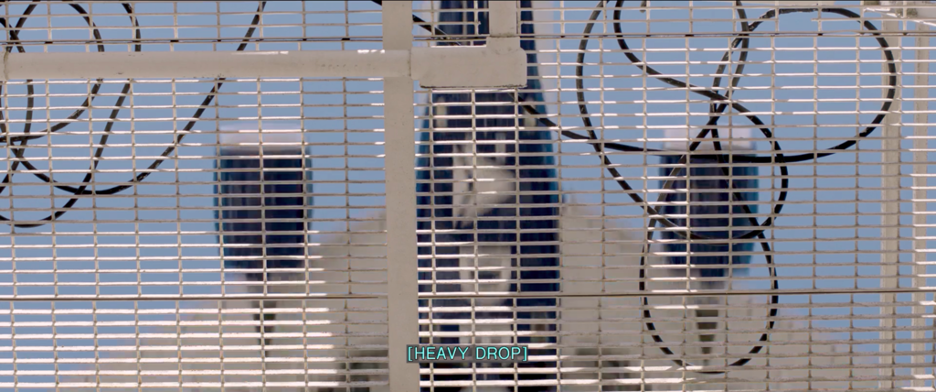
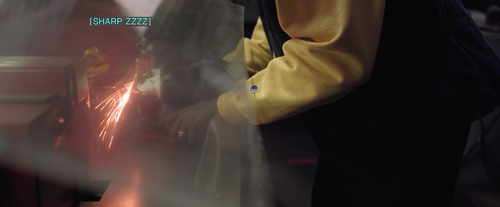
When I began writing captions for the sound design in my own films, I felt the value of my lifelong heightened attention to sound. There is a scene in my film “The Tuba Thieves” in which one of the main characters, Arcey, is sharpening the blades of hockey skates. He holds up the metal blade to the spinning metal wheel of the skate sharpener and orange sparks arc outward. My caption for the sound it makes is simple: [SHARP ZZZZZ] and it sits above the sparks rather than in the standard lower center space of subtitles. Spatially, the caption communicates sonic direction. I don’t think that onomatopoeia is always an accessible choice, because onomatopoeia is a spelling of sound that replicates the hearing of the sound. For someone with complete functional deafness, onomatopoeia doesn’t communicate what sound is outside of hearing, but the shapes of the ZZZZZ’s in this case have a provocative visual jaggedness that does match the sparking against the blade. Related, whenever I have gotten a tattoo, I marvel that the sound of the tattoo gun [GRATING ZZZZ] is the same as the feeling of the pressure of the tattoo gun quickly stabbing the skin. I have never been able to identify other sounds that physically feel the exact same as the sound, but I think the [SHARP ZZZZZ] might be another sound/touch match if one had the misfortune to nick their skin on the blade sharpening machine or get burned by the sparks.
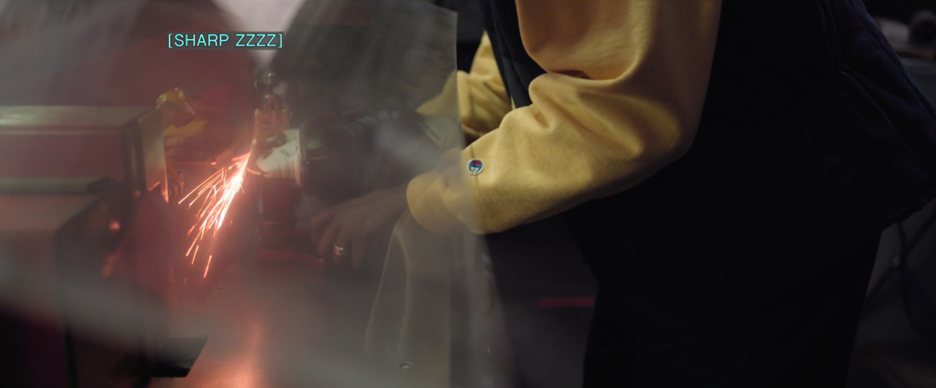
Maybe the perception of sound is trusted more because of language’s onomatopoeiac possibilities. There appears to be an agreement on the sound that velcro makes in that reddit discussion, but there are many options for how to spell the sound. How we listen to things and how they sound is usually not the same as how we articulate and describe how those things sound.
I have had the d/Deaf privilege of observing sound ricochet through the ears, psyches and bodies of hearing people - usually in moments when police and ambulance sirens drive by and in the sudden scream of microphone feedback. Hearing people writhe in pain and they seem like my house in an earthquake – brain and inner ear structure stretched far beyond comfort! These are sounds that do not hurt me and it’s a weird sensation to calmly hear those sounds while everyone around me is suddenly incapacitated. It’s powerful and private and the sound feels removed enough as to be complex and interesting.
My relationship to listening to music with an overt agenda, such as mainstream music and film soundtracks is hesitant, suspicious and tenuous, and very separate from my relationship to listening to daily life and ambient sound, which feels wide open, easy-going, boundless, curious and hungry. Irritation and frustration are not common sonic experiences for me when I am not with people. I love certain sounds the most: air conditioners rumbling on, leaf blower drones, wind, wind in microphones, alarms beeping, construction sounds, traffic whooshes, dogs barking in the distance, the variation of thin and thick air sounds at different sea levels. In public, I take out my hearing aids in loud crowded spaces where voices, chairs scraping, footsteps, background music, and traffic outside blend and combine into comforting unspecific walls around me. Music with lyrics has a physical and social specificity that I often can’t catch up to. Experimental, jazz, classical, and noise music make much more sense to my world of listening. I rarely turn on music when I am alone. Where I live in L.A. now has a specific vocabulary. Outside my window – an abstraction – some cats just loudly, but quickly worked out a feline drama. I like the sound of my fingers tapping right now and my breathing. A boomy firecracker explodes, making the persistent neverending argument that every night in L.A. expresses itself with fireworks! Planes fly nearby toward LAX. On weekend nights, where I live in Los Angeles, I can hear sideshows – gatherings of people spinning their cars in donuts in nearby intersections. It goes on and on, and the next day I hope to drive by and locate the left over black circles of burnt rubber to test my directional hearing. I am always wrong. I have never been able to ascertain where sound moves from and to.
Michael Ned Holte’s book is a year long daily exercise of reflecting on what constructs his musical universe. On day 162, Holte writes the following entry:
“5 a.m. question: Is there a point at which deep listening can go . . . too deep? At times I become preoccupied with certain frequencies, particularly as layers of other sound begin to peel away. It’s a depth where awareness has become attention and can’t ease back to awareness. This is particularly true with the oscillation of certain electric equipment, like my refrigerator or the fan of the digital projector in the classroom where I taught my seminar Pauline Oliveros for Artists. It was certainly true of the HVAC (heating/ventilation/air conditioning) system at the Biltmore Hotel, where I stayed on this particular night, along with a suite of exquisite art works by Kang Seung Lee. The art was utterly silent, the room perfectly chilly. But the hum – emanating from an HVAC system massive enough to heat or cool the hotel’s 683 guest rooms as well as its palatial banquet halls and lobby – grabbed my undivided attention and wouldn’t let go. “Hum” is too pleasant a word for what I was hearing. Far from the kind of elegant drone I tend to enjoy listening to, this sound was thick with partials and overtones. A real wobbler, it was hard to measure its pattern or how often it was repeating. I pictured a sawtooth wave that became increasingly snarled the longer I listened. Would most people ignore this? I suspect yes, which also makes me question whether I am listening too closely to the world sometimes. The discourse around Deep Listening (meaning the practice and pedagogy as defined by Pauline Oliveros) seems to assign positive value to the phrase, but I wonder if we should instead imagine it as a value neutral. Meaning: Deep, yes, but at what cost? Is the tradeoff for good listening a short night of sleep? Would earplugs be cheating?”(Holte 273)
I am in awe of Holte’s attunement and ability to hear and identify partials and overtones. (Though I love the definition and the idea that forms in my mind as a result of reading his words, I don’t think I’ve ever actually been able to hear overtones and I’m trying to comprehend what google just told me partials are.) Holte hears the sound (noise emitted from the HVAC), listens deeply (hears many sounds – overtones, partials), names and visualizes them (wobbling sawtooth wave snarling), and the sound as he described unwittingly becomes accessible sound.
[WOBBLING, SNARLING SAWTOOTH WAVE]
This is a caption I long for in films because this is a sonic and visual compilation, so suggestive that it creates an auditory linguistic register of the aural that reimagines the sonic world. [WOBBLING (unsteady and moving erratically) SNARLING (visual of an animal (or even more frightening – a human) pulling its lips back and baring its teeth) SAWTOOTH (a long metal saw cutting with short teeth) WAVE (sound wave, ocean wave – up and down repetitive pattern, and since we’ve already been here, this again suggests teeth)]. This HVAC with its unpredictable gnashing, biting layers of repetitive, shifting sound is communicating unsettling discomfort. (So maybe now I understand overtones and partials?) This caption could work in a horror film, but much more evocatively in this quiet room where sleep is not coming easily, the words unveil layers of possible meaning through atmosphere, tone, conflict – the longing for rest, and the unrelenting buzz of wakefulness. Further, this scene made by a d/Deaf filmmaker might suggest the fallacy of perfect hearing. No wonder Michael started to question Deep Listening. No wonder he couldn’t sleep.
BIO
Alison O’Daniel is a d/Deaf visual artist and filmmaker who builds a visual, aural, and haptic vocabulary that reveals (or proposes) a politics of sound that exceeds the auditory. O’Daniel’s film ‘The Tuba Thieves’ premiered at the 2023 Sundance Film Festival and is currently on the International film festival circuit. O’Daniel is a United States Artist 2022 Disability Futures Fellow and a 2022 Guggenheim Fellow in Film/Video. She is represented by Commonwealth and Council in Los Angeles and is an Associate Professor of Film at California College of the Arts in San Francisco.
-
d/Deaf is a spelling of the word ‘deaf’ that acknowledges the differences in community involvement. Lowercase deaf refers to someone who is medically or biologically deaf, but is not integrated into Deaf culture. Capital D deaf refers to someone who is immersed in Deaf culture and usually has Sign Language as a first or primary language. Spelling the word d/Deaf might refer to someone who is hard of hearing, or someone whose identity is a bit more fluidly moving between hearing and Deaf worlds. ↩
-
The Infinite Ear was curated by Sandra Tjerdman and Gregory Castera in three different episodes and locations (Bergen Assembly, 2016; Garage Museum of Contemporary Art, Moscow, 2018; Centro Centro, Madrid, 2019.) Infinite Ear – Inquiries – Council. www.council.art/inquiries/30/infinite-ear. ↩
-
From the Infinite Ear website: “Placed at the intersection of different fields of knowledge, A (mis)reader’s Guide to Listening reveals how the visitor’s bodies and concerns participates in the interpretation of a work, and proposes other ways of sensing that may expand the work’s interpretation within and beyond the exhibition space. A (Mis)Reader’s Guide to Listening – Inquiries – Council. www.council.art/inquiries/30/infinite-ear/1104/a-mis-reader-s-guide-to-listening. ↩
-
From Holte’s notes in the end of the book: “Written from January 1 - December 31, 2022, as a daily performance of Pauline Oliveros’s Sonic Meditation XXI. I understand the text as a kind of embodied scholarship on and around Oliveros–a daily record of listening, thinking, reading about musi and sound, and of “being in the moment,” with thoughts accruing and changing over time. Holte, Michael Ned. Good Listener: Meditations on Music and Pauline Oliveros. Sarasota, Sming Sming Books, 2024. ↩
-
From the subreddit r/askscience, user @codefyre was seeking answers to a debate between friends if a "twang" sound heard right before feeling an earthquake was a P-wave. (A geophysicist answered codefyre and said: “P-waves can occur at many different frequencies, depending on the source. Hit your table with your fist. You just generated P-waves and other types of waves. Generally us field geophysicists refer to the sound you hear from the source as the 'air wave' but really, it's a P-wave (compressional wave). Typical active sources for us are things like blasting caps, weight drops, sledgehammers, and vibro trucks. We refer to it as the air wave because it's very slow compared to the first arrivals of the P-waves in the ground, and usually we want to filter it out of the data. Your friend isn't wrong about the fact that earthquake P-waves are generally fairly low frequencies. Most of them are below 20 Hz. Our human hearing range is about 20 Hz - 20,000 Hz. Sometimes the P-waves from earthquakes can refract into the air, and if they had a high enough frequency, they could be heard as air waves (which remember are a type of P-wave).” Codefyre. “Are Earthquake P-Waves Audible?" Reddit, 2015. https://www.reddit.com/r/askscience/comments/4mu1ey/are_earthquake_pwaves_audible/?utm_name=web3xcss ↩
-
From the subreddit r/AskScience, user @ProtienJunky asks the question in the title and adds no other info. TheProtienJunky. “How do you spell the sound velcro makes?”. Reddit, 2017. https://www.reddit.com/r/AskReddit/comments/83r7q1/how_do_you_spell_the_sound_velcro_makes/ ↩